Within South Australia UFOs
What Made Woomera UFO Reports Different?
Woomera's UFO reports matter because unusual lights there could involve witnesses, radar, aircraft, rockets or security concerns.
On this page
- Why the range changed the stakes
- Key sightings and witness evidence
- Likely explanations and unresolved points
Page outline Jump by section
Introduction
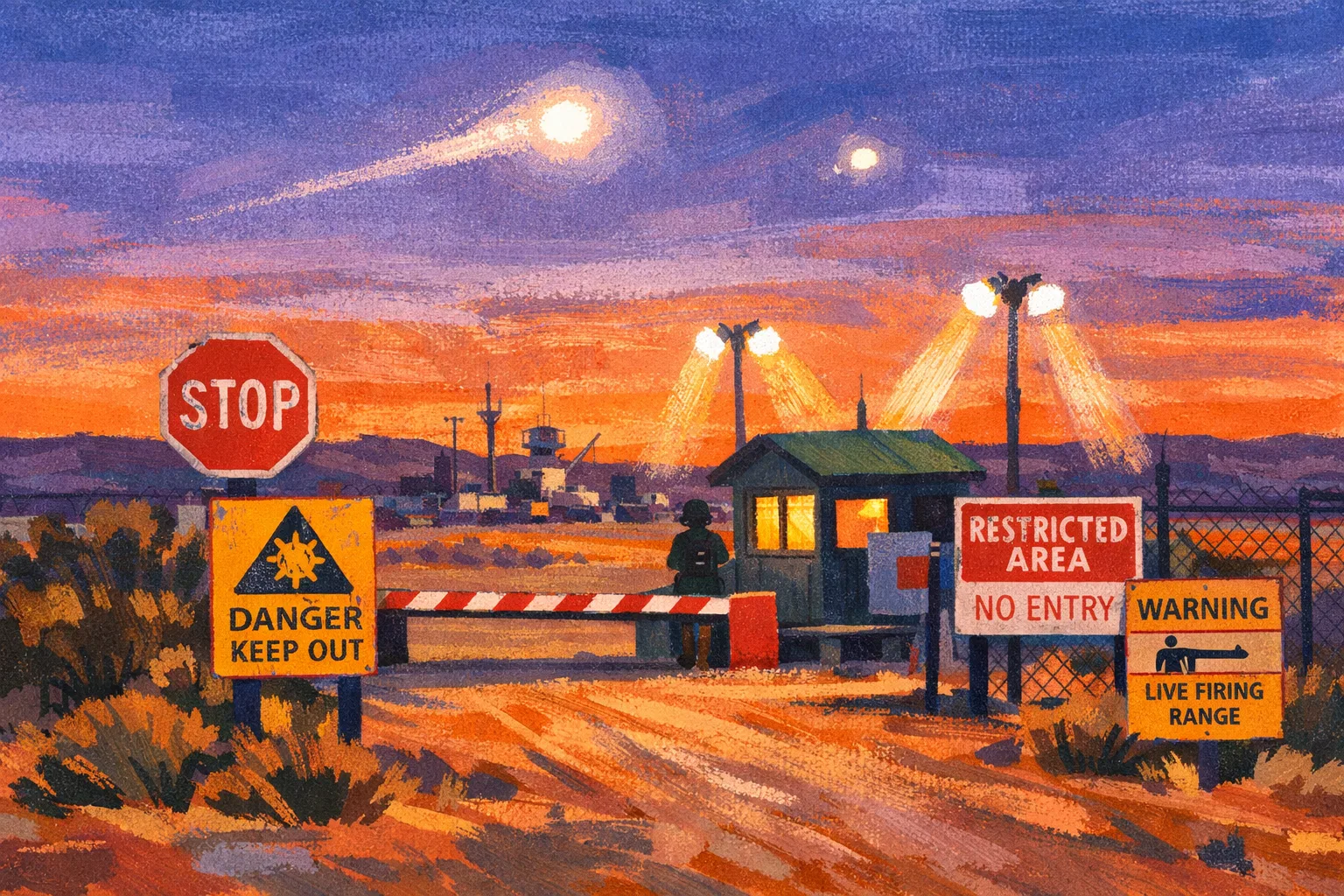
Woomera UFO reports are different from most South Australian sightings because they happened in, or near, a restricted defence and weapons-testing environment. A strange light over an ordinary town might be logged as a curiosity; a strange light near Woomera, Maralinga or the wider Woomera Prohibited Area could raise questions about aircraft, rockets, balloons, satellites, security breaches, instrumentation faults and public secrecy. That does not make the reports proof of extraordinary craft. It makes them better documented, more technically complicated and easier to misunderstand.
The strongest Woomera-related evidence is not a single dramatic photograph or recovered object. It is a paper trail: confidential reports, security inquiries, named witnesses, attempts to check firings and aircraft, and later archival work showing how officials tried to separate mundane explanations from genuine unknowns. The best-known case is the 15 July 1960 Wewak light near Maralinga, where multiple witnesses saw a bright white-to-red light and investigators considered balloons, aircraft flashes, meteors, static electricity, satellite debris and “flying saucer” interpretations before settling on a cautious unresolved-but-probably-natural conclusion.[NAA]naa.gov.auNAAUFO sightings at weapons testing site, Woomera | naa.gov.auNAAUFO sightings at weapons testing site, Woomera | naa.gov.au
Why the range changed the stakes
Woomera’s importance begins with its role, not with UFO folklore. After the Second World War, Australia and the United Kingdom created the Anglo-Australian Joint Project, with Woomera as the centrepiece long-range weapons testing facility. The area was declared a Prohibited Area in 1947, and the first military trial took place in December that year. From 1957 it also became a major space-launch site, and Defence notes that at the height of its space activity Woomera had the second-highest number of rocket launches in the world after Cape Canaveral.[Defence]defence.gov.auDefence History of the Woomera Prohibited Area | Defence Activities | DefenceDefence History of the Woomera Prohibited Area | Defence Activities | Defence
That setting matters because Woomera was full of things that could create strange sky reports. Rockets, missile trials, pilotless aircraft, tracking instruments, balloons, range lights, restricted aircraft movements and later satellite activity all produced observations that might look extraordinary to an unprepared witness. The modern Royal Australian Air Force describes the Woomera Range Complex as including the Woomera Prohibited Area, restricted airspace, Camp Rapier, Nurrungar Test Area and other test infrastructure; its capabilities include a fully instrumented air weapons range, demolition ranges, live firing ranges and target areas for aircraft and artillery.[Air Force]airforce.gov.auAir Force Woomera Range Complex | Air ForceAir Force Woomera Range Complex | Air Force
The same facts cut both ways. On one hand, they make prosaic explanations more likely: a test range is exactly where unusual aircraft, rockets and instruments should be expected. On the other hand, the range made official attention more likely. A report from Woomera or Maralinga could not simply be laughed away if it might indicate an unauthorised aircraft, a failed test, a security leak, a safety issue or an object interfering with range operations.
This is why Woomera has a special place in South Australia’s UFO history. Its reports sit between civilian sighting lore and defence administration. They are not just stories told after the event; in some cases they became memos, security files and correspondence between agencies.

The Wewak light: the clearest defence-range case
The most useful case for understanding Woomera-range UFO evidence is the confidential 1960 report headed “Unidentified light – Wewak Area”. Wewak was the site of the Vixen “A” tests, about 15 miles from Maralinga Village, and it used static balloons for instrumentation. On 15 July 1960, Constable Hubert Dave Scarborough reported what he first thought was a balloon burning in the air. The Balloon Officer checked and found all balloons intact.[NAA]naa.gov.auNAAUFO sightings at weapons testing site, Woomera | naa.gov.auNAAUFO sightings at weapons testing site, Woomera | naa.gov.au
Scarborough’s description was vivid but not precise enough to identify the object. He said he saw a light strong enough to cast bright moonlight-like illumination on the ground, moving east to west. As it appeared to come nearer or grow larger, it changed from white to red. He estimated that it occupied about one and a half to two degrees of the horizon and lasted perhaps 30 seconds, but the report makes clear that distance, size and duration were hard to judge.[NAA]naa.gov.auNAAUFO sightings at weapons testing site, Woomera | naa.gov.auNAAUFO sightings at weapons testing site, Woomera | naa.gov.au
The case became stronger because it was not a single-witness report. Constable Richard Henry Maxwell, at Roadside, also saw a light from the direction of Wewak, though it made little impression on him until Scarborough later phoned. Four other personnel in Maralinga Village saw a light over the R.E.M.E. Workshop Building from the general direction of Wewak: Captain Keith Angus Ross, Trevor James Hoskins, Russell McFarlane Kingsley and Ian Kenneth Haskard. Their duration estimates varied from two to fifteen seconds, but the report judged the longer estimate plausible because one witness could reconstruct his movements at the time.[NAA]naa.gov.auNAAUFO sightings at weapons testing site, Woomera | naa.gov.auNAAUFO sightings at weapons testing site, Woomera | naa.gov.au
The official handling is what makes the case valuable. Investigators checked whether a Woomera firing could have been visible in the area, contacted a survey party near Emu to ask whether they had seen a meteor-like phenomenon, discounted a high-flying aircraft photo-flash because no aircraft was heard and the duration seemed too long, and asked scientific personnel whether the light could have been a practical joke. A scientific officer suggested St Elmo’s fire, or a static-electricity effect associated with the balloon equipment; Oliver Harry Turner, a Health Physics Officer, made his own calculations and argued that the light was not natural, suggesting either a satellite cone or a “flying saucer”. The final report, however, said all Maralinga inquiries had been exhausted and that the source could not be positively identified, while still leaning towards a meteor or static electricity.[NAA]naa.gov.auNAAUFO sightings at weapons testing site, Woomera | naa.gov.auNAAUFO sightings at weapons testing site, Woomera | naa.gov.au
That conclusion is important. It did not say “alien spacecraft”. It also did not say “definitely explained”. The case remained in the more interesting middle category: formally investigated, witnessed by several people, checked against some local explanations, but still lacking decisive instrumental evidence.
Why the 1960 case was investigated so thoroughly
The National Archives of Australia presents the Wewak report as part of the defence and weapons-testing record, not as entertainment. It notes that the report was written on 24 July 1960 by security officer J. J. A. Hanlon and originally formed part of a Department of Supply file on the Weapons Research Establishment in South Australia. The same record was later transferred to the Royal Commission into British Nuclear Tests in Australia in 1984–85.[NAA]naa.gov.auNAAUFO sightings at weapons testing site, Woomera | naa.gov.auNAAUFO sightings at weapons testing site, Woomera | naa.gov.au
The thoroughness had practical reasons. The Archives explains that the Wewak and nearby Taranaki sites sat within the much larger Woomera Prohibited Area, where the Vixen tests were conducted under tight security between 1959 and 1963. It also notes that several dozen witnesses were interviewed in relation to reports associated with the Wewak sightings, including Commonwealth Police, Weapons Research Establishment staff, armed forces personnel and members of the public.[NAA]naa.gov.auNAAUFO sightings at weapons testing site, Woomera | naa.gov.auNAAUFO sightings at weapons testing site, Woomera | naa.gov.au
For readers, the key point is that “defence-range evidence” does not mean “the military confirmed a UFO”. It means the report was pulled into a security, safety and technical environment. Investigators cared because the location mattered. A false alarm could still reveal a hazard, an unauthorised aircraft, a misunderstanding of test activity, or a public-relations problem around secret work.
The 1960 Wewak report also shows how Cold War explanations overlapped. The same unusual light could be discussed as a meteor, static electricity, a balloon-related electrical discharge, a reflected light, a satellite cone or a flying saucer. The National Archives’ educational note says scientific experts consulted on the Wewak reports offered explanations ranging from flying saucers and satellite cones to a meteor, static effects on weather balloons and reflection from distant vehicle lights on a low inversion layer.[NAA]naa.gov.auNAAUFO sightings at weapons testing site, Woomera | naa.gov.auNAAUFO sightings at weapons testing site, Woomera | naa.gov.au
Other Woomera reports were often about security, not aliens
Woomera’s UFO reputation is sometimes inflated by later retellings, but archival summaries suggest a more mixed record. Independent Australian UFO archival researcher Keith Basterfield’s survey of government records describes several Woomera-related files, including Department of Supply and Weapons Research Establishment material. He found reports of unusual objects in the early 1950s, unidentified aircraft over the prohibited area, general public sightings later treated as likely satellites, and gaps where well-known UFO-literature claims do not appear in the official file he examined.[Project 1947]project1947.comkb uasgovkb uasgov
One early case in that survey involved a Woomera kinetheodolite observer, Gunner R. J. Willis, in October 1954. According to the archival summary, Willis was observing a Jindivik pilotless aircraft when he saw a silver-white, half-moon-shaped object moving in a straight line; he reportedly photographed it for about three seconds with a kinetheodolite, a precision optical tracking instrument used on ranges. That kind of claim is more interesting than a casual light report because it involves a trained range observer and possible instrumentation, but the available public summary is still not enough to treat it as a solved extraordinary event.[Project 1947]project1947.comkb uasgovkb uasgov
The same archival survey also mentions 29 July 1953 reports of spherical objects over the range, including an observation by the Range Operations Security Officer. In that instance, the official explanation was apparently much less exotic: the objects were believed to be balls of thistle seeds and vegetation. This is a useful warning against assuming that “seen over Woomera” automatically means “advanced aircraft” or “unexplained technology”.[Project 1947]project1947.comkb uasgovkb uasgov
The most defence-specific reports were not always UFO reports in the popular sense. Some were about unidentified aircraft entering, or possibly entering, restricted airspace. In 1971, for example, a reported unidentified aircraft over the Woomera Prohibited Area shortly before a Black Arrow missile launch was checked against range instrumentation at Parakylia, Red Lake, Roxby Downs and Purple Downs. No confirmation was obtained, and officials considered both a mistaken theodolite identification and an aircraft that had crossed the area without a flight plan; a bird, specifically a wedge-tailed eagle, was also considered possible.[Project 1947]project1947.comkb uasgovkb uasgov
That example captures the real Woomera pattern. The question was not “are aliens here?” It was “what entered or appeared to enter a controlled range, and does it affect safety or security?” In a prohibited area, even a bird, a civil aircraft without a flight plan, or a misunderstood optical sighting could generate paperwork.
Likely explanations: rockets, satellites, aircraft and atmosphere
The most common mistake in reading Woomera UFO material is to treat the range as a place where ordinary explanations are less likely. In fact, many ordinary explanations become more likely because of the range’s function.
Several explanation categories recur:
Range activity. Rocket and missile tests could produce bright lights, unusual trajectories, smoke, debris, engine glow and sudden disappearances. Woomera’s official history notes its major role in rocket and space activity from 1957 onward, including its selection as a launch point for the European Launcher Development Organisation.[Defence]defence.gov.auDefence History of the Woomera Prohibited Area | Defence Activities | DefenceDefence History of the Woomera Prohibited Area | Defence Activities | Defence
Restricted aircraft and drones. Woomera has long been associated with military aviation and test work. The current Air Force description includes air weapons ranges, live firing areas and unmanned aerial systems testing. That does not explain every historical case, but it does mean that unusual aircraft-like observations in the region need careful checking before being labelled anomalous.[Air Force]airforce.gov.auAir Force Woomera Range Complex | Air ForceAir Force Woomera Range Complex | Air Force
Balloons and instrumentation. The Wewak case began because the witness thought a balloon had burned. Although the balloons were found intact, the report still considered static electricity around balloon equipment and St Elmo’s fire as possible explanations. This shows how range hardware could create both real visual effects and misleading first impressions.[NAA]naa.gov.auNAAUFO sightings at weapons testing site, Woomera | naa.gov.auNAAUFO sightings at weapons testing site, Woomera | naa.gov.au
Meteors, satellites and re-entry effects. The Wewak investigation contacted observers to check for meteor-like phenomena, while later Department of Supply files reportedly treated many public sightings as likely satellites. This is especially relevant to Woomera because the region combined dark skies, open horizons and space activity.[NAA]naa.gov.auNAAUFO sightings at weapons testing site, Woomera | naa.gov.auNAAUFO sightings at weapons testing site, Woomera | naa.gov.au
Atmospheric mirage and reflections. The National Archives notes that experts considered reflection from distant vehicle lights on a low inversion layer among the possible Wewak explanations. In flat, arid country, long sightlines and temperature inversions can make lights appear displaced, magnified or oddly mobile.[NAA]naa.gov.auNAAUFO sightings at weapons testing site, Woomera | naa.gov.auNAAUFO sightings at weapons testing site, Woomera | naa.gov.au
These explanations do not make every report trivial. They make the evidential bar higher. A Woomera UFO case is strongest only when it has multiple independent witnesses, timing precise enough to compare with range activity, instrument records, aircraft checks, weather data and a clear chain of documentation.
What strengthened the evidence — and what weakened it
The strongest Woomera-related reports share three features: official paperwork, named or role-identified witnesses, and an investigation that considered more than one explanation. The Wewak report has all three. It gives names and roles, records disagreement over duration, checks local firings and aircraft-flash possibilities, considers electrical and meteor explanations, and preserves the uncertainty rather than forcing a neat answer.[NAA]naa.gov.auNAAUFO sightings at weapons testing site, Woomera | naa.gov.auNAAUFO sightings at weapons testing site, Woomera | naa.gov.au
What weakens the broader Woomera story is the unevenness of the surviving record. Some famous claims in UFO literature are not found in the government files examined by researchers. Basterfield’s archival survey, for example, notes that a purported 1964 photograph from a Blue Streak launch appeared in Flying Saucer Review but was not found in the relevant Woomera file he examined, despite later efforts to trace “unidentified” or “unknown” slide records.[Project 1947]project1947.comkb uasgovkb uasgov
Another weakness is that many sightings are ambiguous by nature. A bright light changing colour, a half-moon object glimpsed while tracking another aircraft, or a possible aircraft seen through a theodolite can be sincerely reported and still remain vulnerable to misperception, range clutter, optical effects or incomplete records. The more complex the environment, the easier it is for a real observation to become a weak UFO case.
There is also the problem of missing or destroyed files. In 2011, Reuters reported that, after a two-month search linked to a Freedom of Information request, Defence could not locate some UFO files, with Headquarters Air Command advising that one file was deemed lost. The only file Defence was then able to locate was reportedly titled “Report on UFOs/Strange Occurrences and Phenomena in Woomera”, and it detailed a sketchy series of sightings including people living in towns near Woomera.[Reuters]reuters.comAustralia's military loses its UFO X-FilesAustralia's military loses its UFO X-Files
That loss should not be overstated. Missing files do not prove a cover-up or extraordinary content. They do, however, weaken historical reconstruction. For South Australia’s UFO history, the result is frustrating: Woomera is one of the places where the official record matters most, yet some of the administrative trail appears incomplete.
How Woomera fits South Australia’s UFO history
Woomera gives South Australia’s UFO record a distinctive defence-range strand. Adelaide newspaper flaps and civilian reports show public interest; Woomera and Maralinga show how unusual sightings could enter official systems because they overlapped with Cold War testing, nuclear secrecy and controlled airspace.
The pattern is not one of confirmed alien craft. It is a pattern of heightened seriousness. At Woomera, a light in the sky might have been a meteor, a satellite, a balloon effect, a rocket-related event, a test aircraft, a bird, a mirage, an unauthorised civil aircraft or something that remained unidentified after reasonable checks. The location made officials ask sharper questions, but it also supplied more possible ordinary answers.
The Wewak case remains the best compact example. It had multiple witnesses, a restricted setting, named personnel, a confidential report and a genuine effort to compare explanations. Yet the final assessment still leaned towards meteor or static electricity rather than a confirmed unknown craft. That is the balanced lesson of Woomera: the defence-range evidence is more serious than casual UFO folklore, but it is also more entangled with the very technologies and conditions most likely to generate puzzling sightings.
Amazon book picks
Further Reading
Books and field guides related to What Made Woomera UFO Reports Different?. Use these as the next step if you want deeper reading beyond the article.
UFOs and Government
Matches the article's emphasis on government inquiries, military involvement, and documentary records rather than sensational claims.

UFOs : Generals, Pilots, and Government Officials Go on the R...
Emphasises credible witnesses and documented cases, echoing the themes of defence personnel and official reporting.
The Report on Unidentified Flying Objects
Focuses on official investigations and the challenge of separating ordinary explanations from genuine unknowns.
The Oz Files: The Australian UFO Story
Covers Australian UFO investigations, official records, and the broader context surrounding cases such as Woomera and other defence-relat...
eBay marketplace picks
Marketplace Samples
Live-tested eBay searches with available results related to this page.



Endnotes
1.
Source: project1947.com
Title: kb uasgov
Link:https://www.project1947.com/kbcat/kb_uasgov.htm
2.
Source: reuters.com
Title: Australia’s military loses its UFO X-Files
Link:https://www.reuters.com/article/oukoe-uk-australia-ufo/australias-military-loses-its-ufo-x-files-report-idUKTRE75620E20110607/
3.
Source: space.com
Title: 11892 australian government loses ufo files
Link:https://www.space.com/11892-australian-government-loses-ufo-files.html
4.
Source: naa.gov.au
Title: NAAUFO sightings at weapons testing site, Woomera | naa.gov.au
Link:https://www.naa.gov.au/students-and-teachers/student-research-portal/learning-resource-themes/war/defence-equipment-and-weapons/ufo-sightings-weapons-testing-site-woomera
5.
Source: defence.gov.au
Title: Defence History of the Woomera Prohibited Area | Defence Activities | Defence
Link:https://www.defence.gov.au/bases-locations/sa/woomera/about
6.
Source: airforce.gov.au
Title: Air Force Woomera Range Complex | Air Force
Link:https://www.airforce.gov.au/about-us/bases/woomera-range-complex
7.
Source: naa.gov.au
Link:https://www.naa.gov.au/students-and-teachers/student-research-portal/learning-resource-themes/war/defence-equipment-and-weapons?page=1
8.
Source: naa.gov.au
Title: flying saucers fact or fiction
Link:https://www.naa.gov.au/blog/flying-saucers-fact-or-fiction
9.
Source: naa.gov.au
Title: fs 129 british nuclear tests at maralinga
Link:https://www.naa.gov.au/sites/default/files/2020-05/fs-129-british-nuclear-tests-at-maralinga.pdf
10.
Source: defencesa.com
Title: test and training areas
Link:https://defencesa.com/precincts/test-and-training-areas/
11.
Source: energymining.sa.gov.au
Link:https://energymining.sa.gov.au/industry/minerals-and-mining/communities-and-land-access/mineral-exploration-and-land-access/defence-land/woomera-prohibited-area
12.
Source: oia.pmc.gov.au
Link:https://oia.pmc.gov.au/sites/default/files/posts/2017/04/woomera_prohibited_area_pir.docx
Additional References
13.
Source: sbs.com.au
Link:https://www.sbs.com.au/news/article/australias-military-loses-its-ufo-x-files/bdnn5c5oz
14.
Source: linkedin.com
Link:https://www.linkedin.com/pulse/australias-forgotten-uap-record-now-part-disclosure-dr-andrew-btobc
15.
Source: facebook.com
Link:https://www.facebook.com/10NewsAU/posts/click-here-for-more-from-the-ufo-witnesses/1378153124351242/
16.
Source: facebook.com
Link:https://www.facebook.com/AustralianArmy/posts/from-factory-floor-to-test-range-the-first-australian-made-gmlrs-missiles-have-b/1394219399408027/
17.
Source: facebook.com
Link:https://www.facebook.com/rnznewzealand/posts/it-remains-the-biggest-mass-sighting-of-a-ufo-in-australian-history/1420616840104260/
18.
Source: facebook.com
Link:https://www.facebook.com/AustralianMillennials/posts/jeopardy-genuinely-convinced-half-of-australia-that-ufos-were-probably-hiding-so/1406492498185492/
19.
Source: facebook.com
Link:https://www.facebook.com/groups/spacehipsters/posts/8448094828568659/
20.
Source: yowiehunters.net
Link:https://yowiehunters.net/viewtopic.php?t=3558
21.
Source: facebook.com
Link:https://www.facebook.com/WWLP22News/posts/scientists-gained-access-to-australias-military-files-on-ufos-and-did-some-resea/10159170341499099/
22.
Source: reddit.com
Link:https://www.reddit.com/r/interestingasfuck/comments/t8mch1/the_woomera_prohibited_area_is_a_raaf_rocket_and/
Topic Tree