Within South Australia UFOs
Did Port Augusta See Saucers Before the Wave?
The 1947 Port Augusta case is notable because it came just before the worldwide saucer wave took hold.
On this page
- The railway workers' account
- Why the date matters
- What the evidence cannot prove
Page outline Jump by section
Introduction
Port Augusta’s early flying-saucer report matters because it appeared on 7 February 1947, more than four months before Kenneth Arnold’s famous 24 June 1947 sighting in the United States popularised the phrase “flying saucer”. In the South Australian case, railway workshop employees said they saw five white or pale pink, egg-shaped objects pass over Port Augusta in formation, fast enough to vanish within seconds. The report did not prove that anything exotic crossed the sky, but it is unusually early, locally specific, and better documented than many later retellings of Australian UFO lore.[Trove]trove.nla.gov.auOpen source on nla.gov.au.
The strongest reading is cautious. The case is significant as a pre-saucer-era Australian report, not as proof of alien craft. Its value lies in the timing, the number of witnesses, the involvement of a named main witness with wartime RAAF experience, and a contemporary comment from South Australia’s Government Astronomer, G. F. Dodwell, who said the report did not fit an obvious astronomical explanation. Its weaknesses are just as important: there was no photograph, no instrument record, no known official aviation investigation, and the published descriptions leave too many gaps to identify the objects with confidence.[Trove]trove.nla.gov.auOpen source on nla.gov.au.
The railway workers’ account
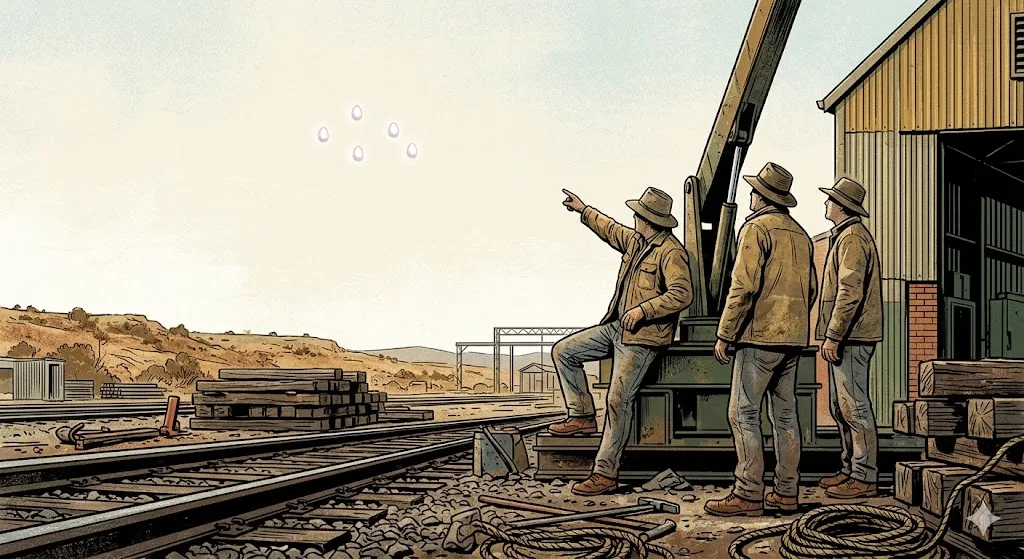
The core report came from Port Augusta’s Commonwealth Railways workshops. According to the Adelaide Advertiser report of 7 February 1947, Mr Ron Ellis and two workmates said they had seen five strange objects cross the sky from north to south while they were working in the yard the previous morning. The objects were described as white or light pink and egg-shaped, not as saucers, discs or aircraft.[Trove]trove.nla.gov.auOpen source on nla.gov.au.
Ellis reportedly could not estimate their size accurately, but judged them to be “about the size of a locomotive” by drawing on his wartime RAAF experience with aircraft. That detail has made the story memorable, but it also needs careful handling. It tells us how large the objects seemed to one witness under brief viewing conditions; it does not establish their real size or distance. The same article said the objects appeared to be at about 6,000 feet, kept a direct course, seemed to quiver, and were out of sight within a few seconds.[Trove]trove.nla.gov.auOpen source on nla.gov.au.
The account was not presented as a lone glance. The newspaper said Ellis and a companion gave matching descriptions within minutes, and that another member of the workshops staff also said he had seen the objects. That makes the report stronger than a single-witness anecdote, but not strong enough to remove ordinary uncertainties. Multiple witnesses can still misjudge altitude, speed, size and distance when an unfamiliar object is seen briefly against the sky.[Trove]trove.nla.gov.auOpen source on nla.gov.au.
One feature stood out in the original article: the objects were said to have cast shadows. If accurate, that would argue against tiny high-speed meteors and against some purely optical explanations. Yet this is also one of the most difficult parts of the report to assess. The article does not give a measured shadow length, direction, lighting geometry, exact duration, or a detailed account from each witness. In a case like this, the word “shadow” may point to something genuinely physical, but it may also reflect a fleeting impression made under bright South Australian morning light.
Why the date matters
The Port Augusta report sits in a narrow and important window. It was published in early February 1947, before the global flying-saucer story had fully formed in newspapers and popular imagination. Arnold’s later sighting near Mount Rainier on 24 June 1947 is widely treated as the moment that gave the modern saucer era its language and public momentum; the Smithsonian’s National Air and Space Museum notes that Arnold’s report added “flying saucer” to public vocabulary.[National Air and Space Museum]airandspace.si.edu1947 year flying saucer1947 year flying saucer
That timing changes how the Port Augusta case should be read. Later reports often have to be judged against the possibility that witnesses, journalists or editors were influenced by already circulating saucer imagery. Port Augusta is different. The witnesses did not report “flying saucers” in the later stock phrase. They described five egg-shaped objects. That does not make the sighting more extraordinary by itself, but it does make it harder to dismiss as a simple imitation of the American saucer wave.
The case also belongs specifically to South Australia’s postwar UFO history. ABC’s later survey of South Australian UFO cases identified Port Augusta as one of the state’s early sightings, with researcher Keith Basterfield noting that five objects were reported by three people at the Commonwealth Railways and that even the Government Astronomer could not explain it.[ABC News]abc.net.auOpen source on abc.net.au.
There is a subtle historical point here: Port Augusta did not become famous in 1947 in the way Arnold, Roswell or later Australian cases did. It was reported, discussed briefly, and then largely absorbed into the background until later UFO researchers recovered it through newspaper archives. That modest public footprint may actually make the case more interesting. It looks less like a sensational national craze and more like a local anomaly that happened to fall just before a worldwide cultural wave.
The official astronomical reaction
The most important contemporary follow-up came from Government Astronomer G. F. Dodwell. In a Transcontinental report published on 14 February 1947, Dodwell was quoted as saying that the phenomenon did not fit anything astronomical and was “a complete mystery” to him. He specifically discounted meteorites, arguing that meteorites were small, travelled at very high speeds, would not cast shadows as described, and would have been accompanied by a deafening roar if falling in the relevant way.[Trove]trove.nla.gov.auOpen source on nla.gov.au.
Dodwell’s comment is often the strongest piece of support cited by people who treat the Port Augusta case as unresolved. It matters because it came from a relevant scientific authority at the time, not from a later enthusiast imposing a UFO interpretation. His statement also addressed a plausible early explanation: that the men had seen meteors. In his view, the reported shadows and lack of roaring sound did not fit that explanation.[Trove]trove.nla.gov.auOpen source on nla.gov.au.
Still, Dodwell’s judgement was limited by the evidence available to him. He was responding to a newspaper report, not to photographs, radar data, recovered material or a structured witness interview. Saying that a report did not fit a meteor explanation is not the same as identifying the objects. It narrows one possibility; it does not prove an extraordinary one.
Later discussion complicates the picture further. Basterfield’s pre-24 June 1947 catalogue records that the weather forecast for 5 February was unsettled, with scattered rain and thunderstorms, warm to hot and sultry conditions away from the coast, and south-easterly to north-easterly winds. That does not solve the case, but it reminds readers that atmospheric conditions were not neutral. Unsettled skies can produce unusual visual effects, cloud forms, lighting contrasts and mistaken impressions of motion.[Project 1947]project1947.comOpen source on project1947.com.

The Lock report and the possibility of a wider observation
A later-discovered related account came from F. W. Flavel of Lock, on Eyre Peninsula, about 225 kilometres south-west of Port Augusta. In Basterfield’s catalogue, Flavel is quoted as saying he saw five objects between 7 and 8 o’clock on the same morning. He described them as oblong, narrow-pointed, smoky grey, apparently coming up out of the sea, moving from north-west to south-east, and causing a shadow. He also said he called his wife to look.[Project 1947]project1947.comOpen source on project1947.com.
This secondary account is important because it offers a possible independent echo of the Port Augusta sighting: five objects, the same morning, shadow-like effects, and a broad regional setting within South Australia. If both reports describe the same phenomenon, the case becomes more than a single workshop-yard incident.
But the Lock account also introduces problems. The direction of travel does not neatly match the Port Augusta description. The time appears earlier. The shape is “oblong with narrow points” rather than simply egg-shaped. The phrase “coming up out of the sea” may describe a low-angle horizon impression rather than a literal origin. The account was also published as a letter-style report after the Port Augusta story had already appeared, so it cannot be treated as wholly insulated from newspaper influence.[Project 1947]project1947.comOpen source on project1947.com.
The best use of the Lock material is therefore modest: it strengthens the possibility that something unusual was noticed across part of South Australia that morning, while also showing how quickly witness descriptions can diverge in time, direction, shape and interpretation.
What the evidence cannot prove
The Port Augusta case is stronger than a rumour but weaker than a solved event. It has named people, a specific workplace, a date, contemporary newspaper coverage, a brief scientific comment, and a possible related report from another South Australian location. Those are real evidential advantages over many vague “old UFO” stories.[Trove]trove.nla.gov.auOpen source on nla.gov.au.
What it lacks is decisive corroboration. There is no known photograph, no surviving aviation log tied to the sighting, no radar track, no official technical report, and no detailed sequence of witness interviews recorded close to the event. The estimate of 6,000 feet, the apparent size of a locomotive, the few-seconds duration, and the impression of great speed cannot all be checked independently. If the distance was wrong, the size and speed estimates could change dramatically.
Several ordinary possibilities remain open, even if none is confirmed from the surviving record:
- Meteors or fireballs: Dodwell rejected meteorites on the reported facts, especially the claimed shadows and lack of roaring sound. That weakens a simple meteor explanation but does not eliminate every brief atmospheric or celestial possibility.[Trove]trove.nla.gov.auOpen source on nla.gov.au.
- Aircraft or military activity: Ellis’s RAAF experience makes a simple aircraft misidentification less satisfying, but not impossible. The report gives no engine sound, markings, vapour trail, or manoeuvre detail that would let modern readers test this properly.
- Weather and optical effects: The unsettled, hot and sultry forecast gives room for unusual lighting or atmospheric effects, though it does not by itself explain five egg-shaped objects in formation.[Project 1947]project1947.comOpen source on project1947.com.
- Witness compression: A fast, brief sighting can turn separate impressions into a coherent story: colour, size, formation, shadow and speed may all be sincere but imperfect reconstructions.
The fair conclusion is unresolved, not confirmed. The case deserves a place in South Australia’s UFO history because it is early, local, and documented. It does not deserve to be upgraded into proof of spacecraft, secret technology or anything else beyond the evidence.

How later reporting changed the story
The Port Augusta report gained much of its modern importance retrospectively. In February 1947 it was a strange local report. By July, after the American saucer wave had erupted, Australian writers could look back and frame the Port Augusta objects as a forerunner. Basterfield’s catalogue reproduces a later Advertiser comment from 10 July 1947 saying that Port Augusta had “started something” and that the egg-shaped apparitions seemed like harbingers of the American “flying saucers”.[Project 1947]project1947.comOpen source on project1947.com.
That later framing both helps and distorts the case. It helps because it preserves the key historical fact: South Australia had a striking aerial-object report before “flying saucer” became the dominant public label. It distorts because once the saucer wave existed, earlier reports could be pulled into the new mythology, even when the original description was not saucer-shaped at all.
Modern summaries sometimes call the objects metallic, saucers, UFOs or “flying eggs”. The safest wording is closer to the original: five white or light pink egg-shaped objects, reported by railway workshop employees at Port Augusta on the morning of 5 February 1947. “UFO” is acceptable in the literal sense of unidentified flying object, but the original report does not justify treating the objects as identified craft.
That distinction is important for South Australian UFO history. Port Augusta is not a grand solution to the UFO question. It is an early case study in how a brief sky observation becomes evidence, then memory, then folklore. Its staying power comes from the tension between two facts: the original report is too specific to ignore, but too incomplete to settle.
Amazon book picks
Further Reading
Books and field guides related to Did Port Augusta See Saucers Before the Wave?. Use these as the next step if you want deeper reading beyond the article.
In Plain Sight: an Investigation Into UFOs and Impossible Sci...
Adds an Australian perspective and explores how historical reports fit into the wider UFO record.
The UFO Experience
Provides historical context and methods for assessing sightings without assuming extraordinary explanations.

UFOs : Generals, Pilots, and Government Officials Go on the R...
Fits a cautious, evidence-focused discussion of historical UFO reports and witness testimony.
Passport to Magonia
Places unusual aerial reports into a broader historical framework, useful for early pre-1947 cases.
eBay marketplace picks
Marketplace Samples
Example marketplace items related to this page. Use the search link to explore similar finds on eBay.
Endnotes
1.
Source: project1947.com
Link:https://www.project1947.com/kbcat/kbpre47.htm
2.
Source: project1947.com
Title: SOUT H AUSTRALIAN UFO REPORTS LISTING
Link:https://www.project1947.com/kbcat/kbsaufo05-1.htm
3.
Source: project1947.com
Title: Keith Basterfield
Link:https://www.project1947.com/kbcat/kbmoreintoz.htm
4.
Source: trove.nla.gov.au
Link:https://trove.nla.gov.au/newspaper/article/30511159
5.
Source: airandspace.si.edu
Title: 1947 year flying saucer
Link:https://airandspace.si.edu/stories/editorial/1947-year-flying-saucer
6.
Source: trove.nla.gov.au
Link:https://trove.nla.gov.au/newspaper/article/168306511
7.
Source: abc.net.au
Link:https://www.abc.net.au/news/2018-02-23/curious-adelaide-ufo-sightings-across-australia/9466950
8.
Source: trove.nla.gov.au
Link:https://trove.nla.gov.au/newspaper/article/270072746
9.
Source: trove.nla.gov.au
Link:https://trove.nla.gov.au/newspaper/article/270084667
10.
Source: trove.nla.gov.au
Link:https://trove.nla.gov.au/newspaper/article/168306418
11.
Source: trove.nla.gov.au
Link:https://trove.nla.gov.au/newspaper/article/93346874
12.
Source: trove.nla.gov.au
Link:https://trove.nla.gov.au/newspaper/article/195086303?searchLimits=exactPhrase%7C%7C%7CanyWords%7C%7C%7CnotWords%7C%7C%7CrequestHandler%7C%7C%7CdateFrom%7C%7C%7CdateTo%7C%7C%7Csortby&searchTerm=quivering+objects++++++++++++
13.
Source: jenikirbyhistory.getarchive.net
Link:https://jenikirbyhistory.getarchive.net/topics/trans%2Baustralian%2Brailway/railway
14.
Source: nationalarchives.gov.uk
Link:https://www.nationalarchives.gov.uk/help-with-your-research/research-guides/railway-workers/
15.
Source: frc.sa.gov.au
Title: Mercury August 2020
Link:https://www.frc.sa.gov.au/__data/assets/pdf_file/0016/800305/Mercury-August-2020.pdf
Published: August 2020
Additional References
16.
Source: youtube.com
Title: We saw UFOs at school. Then came the warnings | Australian Story
Link:http://www.youtube.com/watch?v=UiYJzvoduiY
Source snippet
"Port Augusta" UFO sighting history Strange Objects Reported In Sky - UFO sighting at Port Augusta in 1947 Where's My Yowie...
17.
Source: youtube.com
Title: Strange Objects Reported In Sky
Link:http://www.youtube.com/watch?v=hsIMjNLQZCU
Source snippet
Schoolyard witnesses in mass UFO sighting demand answers | Australian Story...
18.
Source: youtube.com
Title: Mass UFO Sighting Stuns Australia (S5) | The Proof Is Out There | History
Link:http://www.youtube.com/watch?v=O_V4GxU9b-Q
Source snippet
We saw UFOs at school. Then came the warnings | Australian Story...
19.
Source: youtube.com
Title: Schoolyard witnesses in mass UFO sighting demand answers | Australian Story
Link:http://www.youtube.com/watch?v=IhKyQkhOfoM
Source snippet
Australia's 60-year-old UFO mystery | Australian Story...
20.
Source: youtube.com
Title: Australia’s 60-year-old UFO mystery | Australian Story
Link:http://www.youtube.com/watch?v=akkAB9thpvE
Source snippet
Mass UFO Sighting Stuns Australia (S5) | The Proof Is Out There | History...
21.
Source: mrsac.com
Link:https://www.mrsac.com/wp-content/uploads/2024/01/Bulletin-ARH-Articles-to-May-2023.pdf
22.
Source: scribd.com
Link:https://www.scribd.com/document/26540312/Anth-70-Thursday-2nd-Edition
23.
Source: joannenova.com.au
Link:https://joannenova.com.au/2017/03/battery-powered-sa-could-be-100-renewable-for-just-60-90-billion/
24.
Source: facebook.com
Link:https://www.facebook.com/groups/927900341098173/posts/1451494155405453/
25.
Source: guinnessworldrecords.com
Link:https://www.guinnessworldrecords.com/world-records/116237-first-report-of-a-flying-saucer
Topic Tree