Within Tasmania UFOs
Why Pilots Keep Entering Tasmania's UFO Stories
Tasmania's air routes produced repeated reports where aircraft, flashes and lights became hard to interpret over water.
On this page
- Launceston to Melbourne sighting reports
- Bass Strait as a difficult viewing environment
- Aircraft, meteors and misjudged lights
Page outline Jump by section
Introduction
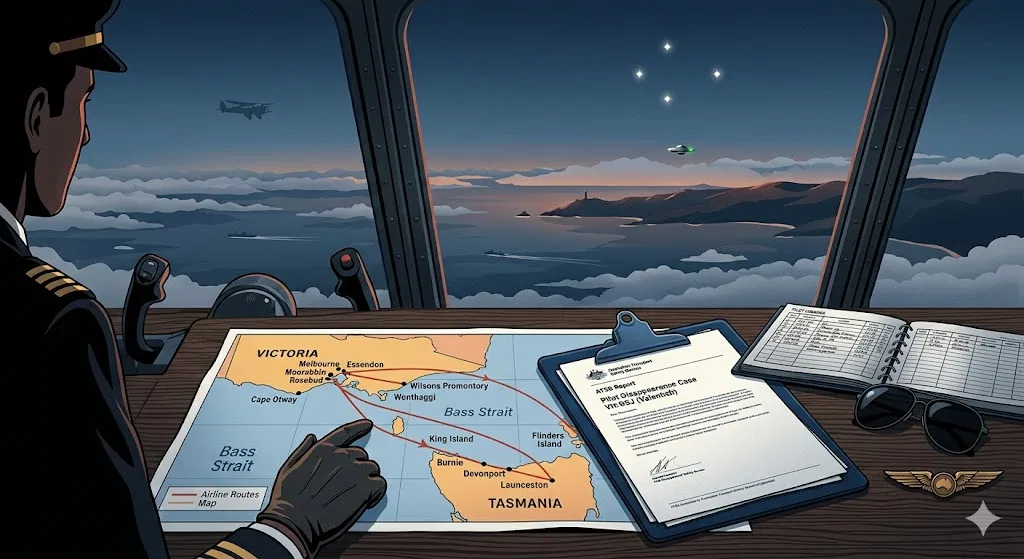
Bass Strait keeps appearing in Tasmania’s UFO stories because it is both a real aviation corridor and a difficult place to interpret lights in the sky. Flights between northern Tasmania, King Island and Melbourne put pilots over dark water, broken cloud, coastal lights, ships, islands and a horizon that can be hard to read, especially at dusk or at night. The result is a small but memorable cluster of aviation-linked reports: some are brief flashes that look like meteors or distant aircraft, some are later folklore wrapped around ordinary crashes, and one — Frederick Valentich’s 1978 disappearance — remains one of Australia’s most famous unresolved aviation mysteries. The strongest lesson is not that Bass Strait is a supernatural zone, but that its geography makes mistakes, uncertainty and dramatic interpretation more likely. Official and aviation-safety sources point to reduced visual cues, spatial disorientation, expectation and misidentified celestial objects as recurring explanations, while leaving a few historical reports unresolved because the evidence is too thin to close the case.[naa.gov.au]naa.gov.auNational Archives of Australia Flying saucers – fact or fiction? | naa.gov.auNational Archives of Australia Flying saucers – fact or fiction? | naa.gov.au
Why Bass Strait makes ordinary lights harder to judge
Bass Strait is not just a strip of water between Tasmania and Victoria. For aviation history, it is a working route: Launceston, Devonport, Burnie, King Island, Flinders Island, Moorabbin, Essendon and Melbourne all sit inside the broader pattern of crossings and approaches that have linked Tasmania with the mainland for a century. That matters for UFO history because pilots and passengers often make their observations from moving aircraft, at altitude, over water, and under time pressure. A light that might be easy to interpret from a fixed ground position can become ambiguous when the observer is banking, descending, communicating with air traffic services or trying to maintain visual orientation.
The Australian Transport Safety Bureau warns that visual-flight pilots need reliable visual cues to maintain orientation; darkness, cloud, rain, fog, smoke or haze can reduce those cues, and the same problem can occur at night even when forward visibility is technically good. The two risks it highlights are loss of orientation leading to loss of control, and controlled flight into terrain when the pilot cannot see enough to remain safely positioned. Over Bass Strait, the “terrain” may be black sea rather than land, but the human-factors problem is similar: without a clear horizon, the body can give false signals about attitude, speed and direction.[ATSB]atsb.gov.auATSBFlying with reduced visual cues | ATSBATSBFlying with reduced visual cues | ATSB
That is why Bass Strait sightings should be read as aviation reports first and UFO stories second. A pilot may be a better-than-average observer of aircraft behaviour, but that does not make them immune to optical illusion, expectation, distraction, fatigue or the limits of night vision. The National Archives of Australia makes the same broad point in its discussion of Australian UFO files: many reports were identified as aircraft or ordinary celestial objects, with the Moon and Venus recurring as explanations, while reports by trained defence or aviation witnesses were treated more seriously because they could carry safety or security implications.[National Archives of Australia]naa.gov.auNational Archives of Australia Flying saucers – fact or fiction? | naa.gov.auNational Archives of Australia Flying saucers – fact or fiction? | naa.gov.au
Launceston to Melbourne reports: brief events, big afterlives
The Launceston–Melbourne corridor is important because it appears in several Bass Strait-linked aviation narratives, but the reports are not all of the same quality. Some are ordinary aviation accidents later folded into “mystery triangle” writing; others are short pilot observations recorded in UFO catalogues and archival references; only a few have enough detail to support careful analysis.
One example often dragged into Bass Strait mystery writing is the disappearance of the de Havilland DH.86 airliner Miss Hobart on 19 October 1934 during a Launceston-to-Melbourne flight. Modern heritage material treats it as an aviation loss: the aircraft carried two crew and nine passengers, disappeared near Wilsons Promontory, and inspired Dr David Warren — whose father was aboard — in his later work on the flight recorder, commonly known as the black box. Heritage Victoria’s submerged aircraft wrecks programme presents the case in aviation-history terms, not as a UFO encounter.[Heritage]heritage.vic.gov.auHeritage Submerged aircraft wrecks programHeritage Submerged aircraft wrecks program
The UFO connection to Miss Hobart appears to be a later overlay rather than a contemporary evidential claim. A specialist catalogue at “UFOs at close sight” argues that the story’s later reputation rests partly on the post-Valentich idea of a Bass Strait equivalent of the Bermuda Triangle, and notes that debris was reported in newspapers after the crash, weakening the claim that the event was a clean vanishing surrounded by unexplained aerial activity.[Ufologie]ufologie.patrickgross.orgOpen source on patrickgross.org.
More directly relevant are the short reports listed by Australian UFO researcher Keith Basterfield from archival and UFO-research sources. His catalogue records a 12 October 1959 report near Wonthaggi in which a “brilliant flash” in the western sky was seen from an ANA aircraft on the Launceston-to-Melbourne route; it is described by elevation and bearing, and the source is given as a National Archives of Australia file. A month later, on 11 November 1959 near Rosebud, an airline pilot on the Melbourne–Launceston route reported a brilliant blue flash with a blue trail to the southern horizon, lasting several minutes.[project1947.com]project1947.comAUSTRALIAN UAP REPORTS - Updated June 3, 2016…
Those reports are useful because they show the pattern without overstating it. They are pilot observations, they involve Tasmanian-mainland air routes, and they were considered notable enough to be catalogued. But they are also brief, light-based events with limited public detail. A brilliant flash, a trail, a bearing and a duration are exactly the kind of record that may point to a meteor, space debris, atmospheric effect or distant aircraft, yet may remain “unidentified” in the archival sense because no definitive matching object was logged.
The 1944 Beaufort “shadow” report: memorable but doubtful
One of the more dramatic Bass Strait pilot stories is the alleged February 1944 Beaufort bomber incident. In the version circulated in UFO literature, T. R. H. Royal was piloting a Beaufort over Bass Strait when a dark “shadow” kept pace with the aircraft for 18 to 20 minutes, showed a flickering light, seemed to emit flames from the rear, and then accelerated away. The same account says radio and direction-finding equipment malfunctioned during the event.[Eklablog]data0.eklablog.comproject 1947project 1947
On its face, that sounds like a classic wartime “foo fighter” style report: a military aircraft, an object pacing it, equipment trouble and a sudden departure. But the case is also a good example of why Tasmanian and Bass Strait UFO material needs source discipline. Basterfield’s later catalogue notes that a search of National Archives material suggested Royal was not a pilot at the time the incident was said to have occurred, and that no contemporary account had been located. His online catalogue similarly says there is doubt because the source is much later and the service-record check does not comfortably support the claimed flight.[project1947.com]project1947.comAUSTRALIAN UAP REPORTS - Updated June 3, 2016…
The fairest reading is therefore cautious. The 1944 story belongs in a Bass Strait aviation-sighting page because it has become part of the route’s UFO tradition, but it should not be presented as a strong case. Its value is mainly historiographical: it shows how a striking aviation tale can survive in UFO catalogues even when later archival checking weakens the witness-and-flight foundation.

Frederick Valentich and the case that fixed Bass Strait in UFO memory
The Valentich disappearance is the reason Bass Strait became internationally familiar in UFO writing. On 21 October 1978, 20-year-old private pilot Frederick Valentich departed Moorabbin in a Cessna 182L, registration VH-DSJ, for King Island. The official Department of Transport accident summary records his intended route, the aircraft type, his approximate 150 total flying hours, his private licence, and his authorisation to operate at night in visual meteorological conditions. It also records that he had obtained a weather briefing, filed a night flight plan and departed Moorabbin at 1819 hours.[ATSB]atsb.gov.auOpen source on atsb.gov.au.
The extraordinary part is the radio transcript. At 1906, Valentich asked Melbourne Flight Service whether there was known traffic below 5,000 feet. He then described what seemed to him like a large aircraft, four bright lights or landing lights, an object passing at speed, and no known Air Force aircraft in the vicinity. As the exchange continued, he said it was “not an aircraft”, described a long shape, reported something stationary or orbiting above him, and mentioned a green light and a shiny or metallic appearance.[ATSB]atsb.gov.auOpen source on atsb.gov.au.
The final official page is stark. Valentich reported rough idling, said his intention was to continue to King Island, then said the “strange aircraft” was hovering above him again and was “not an aircraft”. After 17 seconds of open microphone, there were no further transmissions. The report states that the Cape Otway area weather was clear, visibility excellent and winds light; search-and-rescue procedures were activated, an intensive air, sea and land search continued until 25 October, and no trace of the aircraft was found. The official opinion as to cause was: “The reason for the disappearance of the aircraft has not been determined.”[ATSB]atsb.gov.auOpen source on atsb.gov.au.
That official wording matters. It does not validate an extraterrestrial explanation, but it also does not reduce the event to a proven simple crash scenario. It leaves the disappearance unresolved in the formal aviation sense: the aircraft and pilot were presumed lost, the cause was not determined, and the radio exchange gave the case a lasting UFO significance.
Why later interpretations divide so sharply
The Valentich case has two very different afterlives. UFO-oriented accounts emphasise the recorded voice of a pilot reporting an unknown object, the lack of wreckage, the open-microphone sounds, and later reports from people who said they saw unusual lights around Bass Strait or nearby coastal areas. Sceptical and aviation-safety accounts focus on the pilot’s relative inexperience, the night-over-water environment, distraction, possible spatial disorientation, and the possibility that bright planets or stars were misread as a structured object.
The National Archives summary leans toward the prosaic interpretation. It notes that Valentich was a UFO enthusiast, that he had reported a sighting previously, and that Venus, Mars, Jupiter and Antares were highly visible in a diamond-like formation at the time. Its suggested mechanism is that a striking celestial arrangement, combined with inexperience, may have led him to imagine a craft above him and become fatally distracted from his instruments.[National Archives of Australia]naa.gov.auNational Archives of Australia Flying saucers – fact or fiction? | naa.gov.auNational Archives of Australia Flying saucers – fact or fiction? | naa.gov.au
A more detailed sceptical reconstruction by James McGaha and Joe Nickell argues that Valentich could have connected four bright celestial points into a perceived shape, interpreted the “green light” through confusion or aircraft navigation-light effects, and then become spatially disorientated. They propose a spiral-dive scenario, noting that the final rough-running engine report could fit high forces or fuel-flow interruption in unusual attitude.[Skeptical Inquirer]skepticalinquirer.orgOpen source on skepticalinquirer.org.
CASA’s Flight Safety Australia article takes a similar safety-first line without pretending that every detail is solved. It says expectation bias, spatial disorientation and pilot distraction are real hazards, and quotes the same celestial-object explanation while also acknowledging that the mystery remains open to projection because different observers emphasise different facts. Its practical lesson is not “there was no mystery”, but that cross-checking, trusting instruments, prioritising aircraft control and flight planning are the boring safeguards that matter when a pilot’s attention is captured by something outside the aircraft.[Flight Safety Australia]flightsafetyaustralia.comFlight Safety Australia Leaving this world | Flight Safety AustraliaFlight Safety Australia Leaving this world | Flight Safety Australia
Aircraft, meteors and misjudged lights
Across the Bass Strait aviation reports, the most plausible explanations are usually mundane but not always provable. The category “UFO” here often means “not identified from the surviving information”, not “physically extraordinary”. The likely explanation depends on the report type.
For a brilliant flash or short-lived trail seen from an aircraft, a meteor or re-entering debris is often a stronger first hypothesis than a machine flying near the aircraft. The 1959 Launceston–Melbourne and Melbourne–Launceston entries are brief enough that this kind of explanation remains plausible, especially because the descriptions centre on flashes, trails and apparent direction rather than sustained manoeuvring around the aircraft.[project1947.com]project1947.comAUSTRALIAN UAP REPORTS - Updated June 3, 2016…
For a light that seems to pace, orbit or hover, the explanation may involve relative motion. A star, planet, distant aircraft, ship light or coastal light can appear to change position when the observer’s aircraft turns, climbs or banks. Over water, the absence of nearby fixed references makes this worse. ATSB’s warning about reduced visual cues is directly relevant: pilots under visual flight rules need outside references to know which way is up, and night can remove those references even when the air itself is clear.[ATSB]atsb.gov.auATSBFlying with reduced visual cues | ATSBATSBFlying with reduced visual cues | ATSB
For longer, more dramatic stories, the best question is not “what was the object?” but “how good is the chain of evidence?” The 1944 Beaufort “shadow” report is striking, but later file checks cast doubt on the claimed flight context. The 1934 Miss Hobart loss is a real Bass Strait aviation tragedy, but the UFO aura around it appears to be retrospective rather than grounded in a strong contemporary sighting record. The Valentich disappearance, by contrast, has official documentation and a radio transcript, which is why it deserves more careful attention even when sceptical explanations are persuasive.[eklablog.com]data0.eklablog.comproject 1947project 1947
What the Bass Strait pattern adds to Tasmania’s UFO history
Bass Strait gives Tasmania’s UFO history its strongest aviation thread. Cressy supplies the state’s classic land-based sighting; Valentich supplies the aviation mystery; the Launceston–Melbourne and Melbourne–Launceston reports show that the air routes themselves produced shorter, harder-to-classify observations. Together, they explain why pilots keep entering Tasmania’s UFO stories: not because pilots are infallible, but because pilots are often the people looking into difficult skies from difficult positions.
The pattern also helps separate stronger cases from weaker ones. A report is stronger when it has named witnesses, immediate reporting, official paperwork, independent corroboration, radar or physical evidence, and a clear separation between what was actually observed and what was later inferred. It is weaker when it appears decades after the event, depends on retelling, folds ordinary crashes into “triangle” folklore, or turns a flash of light into a structured craft without enough data.
For readers trying to understand Tasmania’s UFO record, Bass Strait is best treated as a mechanism rather than a magic place. It creates the conditions in which aircraft, meteors, planets, coastal lights, ships, cloud, darkness and human perception can combine into reports that feel vivid and sincere. Some are probably explainable. Some are too poorly documented to resolve. Valentich remains the exceptional case because a pilot disappeared while reporting something he could not identify, and the official investigation could not determine why.
Amazon book picks
Further Reading
Books and field guides related to Why Pilots Keep Entering Tasmania's UFO Stories. Use these as the next step if you want deeper reading beyond the article.
The Hynek UFO Report
Focuses on evaluating witness reports and mistaken observations, matching the article's emphasis on interpreting aerial sightings.
The UFO Experience
Provides a balanced investigation framework for UFO reports, fitting discussions of pilot observations, misidentifications, and the Valen...
Fate is the Hunter
Explores pilot perception, weather, navigation, and uncertainty in flight—core themes behind many Bass Strait sighting reports.
The Killing Zone: How & Why Pilots Die
Addresses spatial disorientation, judgment errors, and visual limitations that help explain unusual aerial observations over water.
eBay marketplace picks
Marketplace Samples
Example marketplace items related to this page. Use the search link to explore similar finds on eBay.

Endnotes
1.
Source: atsb.gov.au
Title: ATSBFlying with reduced visual cues | ATSB
Link:https://www.atsb.gov.au/flying-reduced-visual-cues
2.
Source: atsb.gov.au
Link:https://www.atsb.gov.au/sites/default/files/investigation-reports/197802563.pdf
3.
Source: project1947.com
Link:https://www.project1947.com/kbcat/kbmoreintoz.htm
Source snippet
AUSTRALIAN UAP REPORTS - Updated June 3, 2016...
Published: June 3, 2016
4.
Source: data0.eklablog.com
Title: project 1947
Link:https://data0.eklablog.com/scienceetovnis/perso/project%201947.pdf
5.
Source: aviation-safety.net
Link:https://aviation-safety.net/wikibase/wiki.php?id=166155
6.
Source: weather.gov
Link:https://www.weather.gov/hfo/windbarbinfo
7.
Source: naa.gov.au
Title: National Archives of Australia Flying saucers – fact or fiction? | naa.gov.au
Link:https://www.naa.gov.au/blog/flying-saucers-fact-or-fiction
8.
Source: heritage.vic.gov.au
Title: Heritage Submerged aircraft wrecks program
Link:https://www.heritage.vic.gov.au/our-programs-and-initiatives/submerged-aircraft-wrecks-program
9.
Source: ufologie.patrickgross.org
Link:https://www.ufologie.patrickgross.org/acufo/1934-10-19-victoria.htm
10.
Source: skepticalinquirer.org
Link:https://skepticalinquirer.org/2013/11/the-valentich-disappearance-another-ufo-cold-case-solved/
11.
Source: flightsafetyaustralia.com
Title: Flight Safety Australia Leaving this world | Flight Safety Australia
Link:https://www.flightsafetyaustralia.com/2025/02/leaving-this-world/
12.
Source: naa.gov.au
Link:https://www.naa.gov.au/students-and-teachers/student-research-portal/learning-resource-themes/war/defence-equipment-and-weapons/ufo-sightings-weapons-testing-site-woomera
13.
Source: naa.gov.au
Link:https://www.naa.gov.au/explore-collection
14.
Source: atsb.gov.au
Link:https://www.atsb.gov.au/sites/default/files/media/29971/b20070063.pdf
15.
Source: atsb.gov.au
Title: spatial disorientation after losing visual reference
Link:https://www.atsb.gov.au/news/2025/spatial-disorientation-after-losing-visual-reference
16.
Source: patreon.com
Title: Frederick Valentich
Link:https://www.patreon.com/posts/frederick-flight-155644059
17.
Source: weather.metoffice.gov.uk
Link:https://weather.metoffice.gov.uk/specialist-forecasts/coast-and-sea/shipping-forecast
18.
Source: casa.gov.au
Title: visual flight rules guide
Link:https://www.casa.gov.au/sites/default/files/2022-02/visual-flight-rules-guide.pdf
19.
Source: casa.gov.au
Link:https://www.casa.gov.au/sites/default/files/2021-06/safety-behaviours-human-factor-for-pilots-9-human-information-processing.pdf
20.
Source: casa.gov.au
Link:https://www.casa.gov.au/sites/default/files/2024-07/avsafety-spatial-disorientation-card.pdf
21.
Source: bom.gov.au
Link:https://www.bom.gov.au/marine/wind.shtml
22.
Source: catalogue.nla.gov.au
Link:https://catalogue.nla.gov.au/catalog/6150730
23.
Source: trove.nla.gov.au
Link:https://trove.nla.gov.au/newspaper/article/122408572
24.
Source: iheart.com
Title: Frederick Valentich
Link:https://www.iheart.com/podcast/263-strewth-australian-true-cr-291925532/episode/frederick-valentich-the-flight–330281511/
25.
Source: iheart.com
Title: Frederick Valentich
Link:https://www.iheart.com/podcast/263-strewth-australian-true-cr-291925532/episode/frederick-valentich-the-unanswered–330573444/
26.
Source: dasa.defence.gov.au
Title: defence.gov.au SPATIA L DISORIENTATION
Link:https://dasa.defence.gov.au/sites/default/files/Spotlight_EDT_0125.pdf
27.
Source: flightsafetyaustralia.com
Title: visual flight rules quiz summer 2025 26
Link:https://www.flightsafetyaustralia.com/2026/02/visual-flight-rules-quiz-summer-2025-26/
28.
Source: flightsafetyaustralia.com
Title: dont believe your ears 2
Link:https://www.flightsafetyaustralia.com/2018/01/dont-believe-your-ears-2/
29.
Source: flightsafety.org
Title: wrong turn
Link:https://flightsafety.org/asw-article/wrong-turn/
Additional References
30.
Source: youtube.com
Title: UFOs or PILOT error? | The Disappearance of Frederick Valentich
Link:https://www.youtube.com/watch?v=6LNnWxi_lw4
Source snippet
The Pilot Who Vanished After Reporting a UFO - Fred Valentich...
31.
Source: youtube.com
Title: 665 // Frederick Valentich
Link:https://www.youtube.com/watch?v=AA_JueUmgqM
Source snippet
The Pilot Who Vanished in Seconds —The Haunting Last Transmission of Frederick Valentich! #atc...
32.
Source: youtube.com
Title: The Pilot Who Vanished After Reporting a UFO
Link:https://www.youtube.com/watch?v=oByeIlDd8M4
Source snippet
The Pilot Who Disappeared Forever After Spotting a UFO...
33.
Source: facebook.com
Link:https://www.facebook.com/CivilAviationSafetyAuthority/posts/a-routine-cross-country-flight-turned-into-a-nightmare-when-the-vfr-licensed-pil/1319153783653279/
34.
Source: pprune.org
Link:https://www.pprune.org/pacific-general-aviation-questions/672526-ditching-bass-strait.html
35.
Source: hobartandbeyond.com.au
Link:https://hobartandbeyond.com.au/blog/fly-fishing-and-flying-saucers-5-things-to-do-at-cressy/
36.
Source: monumentaustralia.org
Link:https://www.monumentaustralia.org/themes/people/aviation/display/30627-frederick-valentich
37.
Source: clubmarine.com.au
Link:https://www.clubmarine.com.au/explore-boating/articles/how-to-understand-weather-forecasting.html
38.
Source: aviationtheory.net.au
Link:https://aviationtheory.net.au/wp-content/uploads/2018/09/04-Night-Flight-Rules-and-Proc.pdf
39.
Source: aeroclubmaritime.com
Link:https://www.aeroclubmaritime.com/files/live/sites/aeroclubmaritime/files/pdf/CAA%20NVFR.pdf
Topic Tree