Within WA UFOs
Why RAAF Pearce Logged Strange Sightings
RAAF Pearce shows why official UFO interest often meant air-safety checking rather than belief in extraordinary craft.
On this page
- Unusual Aerial Sightings paperwork
- Pearce, Watheroo and aircraft checks
- When military explanations solved reports
Page outline Jump by section
Introduction
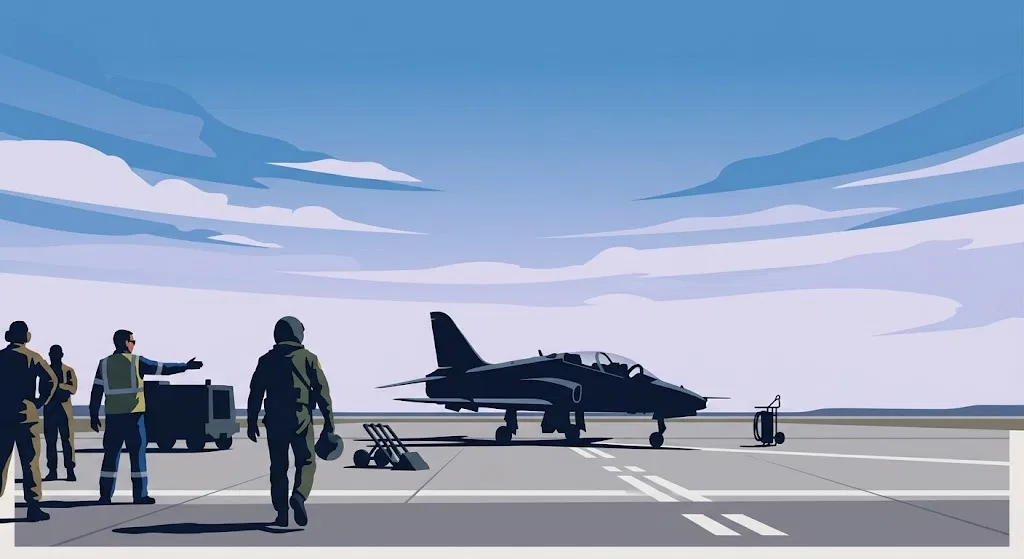
RAAF Pearce matters in Western Australia’s UFO history because it shows the practical, bureaucratic side of official interest in strange lights: checking air safety, radar coverage, aircraft movements and possible defence relevance, not proving exotic craft. The base, at Bullsbrook north of Perth, was the state’s main RAAF point of contact for many “Unusual Aerial Sightings” reports during the late official era, especially when reports came through aviation channels rather than newspapers or UFO clubs. Defence describes Pearce as Western Australia’s main Air Force base, one of the busiest RAAF bases by aircraft movements, and home to pilot training, Hawk 127 fighter-trainers, PC-21 training aircraft and air traffic control functions.[Air Force]airforce.gov.auAir Force RAAF Base Pearce | Air ForceAir Force RAAF Base Pearce | Air Force
The surviving paper trail is revealing but modest. A Department of Aviation file from the early 1980s shows reports being referred to RAAF Base Pearce, including a Watheroo-area sighting by an experienced commercial pilot, while another query was answered with a conventional astronomical explanation: Jupiter rising. These records do not settle every case, but they strongly suggest that Western Australia’s aviation-linked UFO reports were usually treated as a classification and safety problem before they were treated as a mystery.[theblackvault.com]documents.theblackvault.comOpen source on theblackvault.com.
Why Pearce became the obvious place to send WA reports
RAAF Pearce was not just a convenient name on a file. It was the only permanent RAAF base on the west coast, with a significant logistics role as well as its pilot-training role. That made it the natural military address when Western Australian aviation authorities received a report that might involve aircraft, airspace, radar or defence implications.[Air Force]airforce.gov.auAir Force RAAF Base Pearce | Air ForceAir Force RAAF Base Pearce | Air Force
This matters because many UFO stories sound more dramatic when stripped of their administrative setting. A witness may remember “the RAAF investigated”, while the file may show something narrower: a civil aviation office forwarded a letter, a base intelligence officer checked whether there was a known aircraft or celestial explanation, and the case was either left unresolved or closed without evidence of a threat. The National Archives of Australia notes that RAAF UFO records survive in the national archival collection, and that the government’s interest sat within Cold War and space-race caution rather than a simple belief in alien visitation.[NAA]naa.gov.auNAAFlying saucers – fact or fiction? | naa.gov.auNAAFlying saucers – fact or fiction? | naa.gov.au
Pearce’s aviation environment also made ordinary explanations more likely to be checked. Modern Defence material describes the base as supporting advanced flying training for Air Force and Navy pilots, and the Air Force page lists No. 2 Flying Training School, No. 79 Squadron, PC-21 trainers, Hawk 127 fighter-trainers and No. 453 Squadron Pearce flight air traffic control among the base’s functions. A region with regular military training, civil air traffic and long dark-sky distances naturally produces reports that need to be compared against aircraft activity before they can be left as “unidentified”.[Defence]defence.gov.auDefence RAAF Pearce | DefenceDefence RAAF Pearce | Defence
Unusual Aerial Sightings paperwork
The official phrase “Unusual Aerial Sightings” is important because it shows how the RAAF framed the subject. It was not a category reserved for spacecraft claims. It was a reporting label for things in the sky that had not yet been identified. The National Archives says many Australian sightings were recorded on special RAAF forms, and that public reports were often found to be aircraft, the Moon, Venus or other ordinary celestial objects.[NAA]naa.gov.auNAAFlying saucers – fact or fiction? | naa.gov.auNAAFlying saucers – fact or fiction? | naa.gov.au
A key Western Australian source is National Archives file series K95, control symbol 1986/871, a Department of Aviation file titled around “Aerial Phenomenon” and UFO sightings. Researcher Keith Basterfield’s catalogue of Australian government UAP files lists it as a Perth-held Department of Aviation file covering 1982–1986, while a later discussion of the digitised file notes that it includes withheld folios as well as open correspondence about WA reports.[Project 1947]project1947.comOpen source on project1947.com.
The file shows the hand-off mechanism clearly. In March 1983, the Department of Aviation wrote to a Watheroo correspondent saying that his report of a 25 February 1983 sighting had been forwarded to the Officer Commanding, RAAF Base Pearce, “for information and necessary action”. A matching memo sent the same report to Pearce. The language is sober and administrative; it does not imply confirmation of an unknown craft, only that Pearce was the proper military body to receive it.[documents.theblackvault.com]documents.theblackvault.comOpen source on theblackvault.com.
The same file also shows how privacy and access limits affect later research. The digitised copy includes masks for withheld material, and Basterfield’s account notes that some folios were withheld because they were outside the access period or contained personal details. That leaves today’s reader with a partial record: enough to see the process, but not always enough to reconstruct every investigation step or final assessment.[documents.theblackvault.com]documents.theblackvault.comOpen source on theblackvault.com.
Pearce, Watheroo and aircraft checks
The Watheroo-linked 25 February 1983 report is one of the most useful Pearce-related WA examples because it came through aviation channels and was made by a witness with flight experience. The witness wrote to the Department of Aviation after first phoning the Flight Service Officer at Perth Briefing at 2030. He described a fast-moving set of three intense silver-gold lights, roughly 20–30 degrees above the horizon, travelling in an arc with a downward trajectory and then apparently turning or accelerating. He said there was no sound, no afterburner glow, no smoke, and no obvious reflection source.[documents.theblackvault.com]documents.theblackvault.comOpen source on theblackvault.com.
Several details make the report stronger than a casual “light in the sky” anecdote. The observer said he had held a commercial pilot licence for 18 years, had 3,500 hours’ flying experience in Australia and New Guinea, and had 20/20 eyesight. The accompanying sketch placed the witnesses in a moving vehicle near the Mogumber-to-Bindoon Road, about 0.75 kilometres from an Esso depot, with the lights in the eastern sky moving north to south.[documents.theblackvault.com]documents.theblackvault.comOpen source on theblackvault.com.
Those details still do not make the case extraordinary. The report was made from a moving car, the distance and speed were estimates, and the sighting was brief enough that perspective errors could matter. The witness’s aviation experience helps establish that he was familiar with ordinary aircraft cues, but it does not eliminate all possible sources of misperception, reflection, military activity, meteors or distant aircraft lighting. The best reading is cautious: the Watheroo report is a credible, well-documented aviation-linked sighting, but the open file does not provide enough follow-up evidence to prove an unusual craft.
What the report does show is how WA’s aviation system worked. A member of the public with aviation knowledge reported to a flight-service channel; the Department of Aviation recorded the account; the file was sent to Pearce. That is exactly the kind of official pathway that can later look more mysterious than it was. The fact that RAAF Pearce received the report demonstrates official routing, not official endorsement of the witness’s interpretation.[ufos-scientificresearch.blogspot.com]ufos-scientificresearch.blogspot.comUnidentified Anomalous PhenomenaUnidentified Anomalous Phenomena
Watheroo was not the only aviation-linked thread
The same Department of Aviation file includes a 1982 exchange that is just as important because it shows a report being plausibly solved. In July 1982, the Department replied to a Mr Ferguson of Australind, explaining that the only civil radar for air traffic control purposes was at Kalamunda and had a range of 160 nautical miles. The letter added that reports of odd aerial phenomena were referred to RAAF Base Pearce.[documents.theblackvault.com]documents.theblackvault.comOpen source on theblackvault.com.
That exchange concerned a March 1982 Wagin-area nocturnal light report. The Department’s reply said its initial understanding, based on advice from the Observatory, was that the light had been caused by Jupiter rising. Basterfield’s summary of the file says the original query involved a nocturnal light that seemed to interfere with a car radio and was reportedly also seen by a police officer, but the open official response points to a conventional astronomical explanation rather than an aircraft or unknown object.[ufos-scientificresearch.blogspot.com]ufos-scientificresearch.blogspot.comUnidentified Anomalous PhenomenaUnidentified Anomalous Phenomena
This is the kind of case that is easy to misunderstand. To a witness, a bright planet low on the horizon can appear oddly placed, persistent and more impressive than expected, especially before dawn or when seen from a moving vehicle. To investigators, the key question was not whether the witness was sincere, but whether time, direction, horizon position and astronomical data matched a known object. In this instance, the official answer weakened the UFO interpretation.
The Kalamunda radar reference also shows a limit in the evidence. A radar installation with a 160-nautical-mile range could help with some air-traffic questions, but absence of a public radar trace in the surviving file is not the same as proof that nothing happened. It simply means the open paperwork does not provide the kind of calibrated radar data that would turn a witness report into a stronger aviation case.[documents.theblackvault.com]documents.theblackvault.comOpen source on theblackvault.com.

When military explanations solved reports
RAAF Pearce-linked material is most valuable when it is read as governance evidence: it shows how reports were filtered, not just what witnesses saw. The 1980s were a period when the RAAF was already questioning the value of full-scale follow-up. A newspaper clipping preserved in the Department of Aviation file discussed a 1984 decision under which the RAAF would remain the first point of contact, but reports without defence or security implications would be recorded and not investigated further; observers could instead be given civilian research organisation addresses. The clipping also said past investigations had consumed RAAF, Aviation Department and Bureau of Meteorology effort, and that most reported sightings were explained.[documents.theblackvault.com]documents.theblackvault.comOpen source on theblackvault.com.
That national shift helps explain the WA files. Pearce could receive reports, but the goal was increasingly triage: does this involve air safety, defence, a possible aircraft emergency, space debris, or a security concern? If not, the report might be logged rather than chased. The National Archives gives the broader endpoint: the RAAF ceased investigating UFO sightings in 1994, reasoning that only about 3 per cent of reports were unexplained by natural phenomena and that these presented little or no threat to security.[NAA]naa.gov.auNAAFlying saucers – fact or fiction? | naa.gov.auNAAFlying saucers – fact or fiction? | naa.gov.au
Later reporting confirms the same direction. SBS reported in 2015 that members of the public reporting unusual aerial sightings to RAAF personnel would be referred to civilian UFO organisations unless the matter had defence, security or public safety implications, such as crashing aircraft or falling space debris. SBS also reported that Defence instructions said the official UFO function had ended in 1996 because there was no compelling reason to keep devoting resources to recording and investigating UAS.[SBS Australia]sbs.com.auSBS Australia If you see an UFO, don't call the RAAF | SBS NewsSBS Australia If you see an UFO, don't call the RAAF | SBS News
For Western Australia, this means Pearce should not be treated as a hidden UFO command centre. It was a military base embedded in the state’s aviation system. Its involvement is significant because it shows that some reports reached official channels, but it also shows that official attention usually meant risk assessment and elimination of ordinary causes.
The Learmonth example and Pearce’s late-era role
RAAF Pearce also appears in later WA UAS discussion through a 1987 incident at RAAF Learmonth, near Exmouth. According to Basterfield’s account, two members of the Special Air Service taking part in night exercises at Learmonth reported an unusual light that approached in a zig-zag manner, hovered for several minutes, changed from white to amber, moved into cloud, then departed to the north-east at speed. An Army investigating officer reportedly wrote that the cause was unknown, and the report was forwarded to the RAAF, where it was received by Squadron Leader Brett Biddington at RAAF Base Pearce.[ufos-scientificresearch.blogspot.com]ufos-scientificresearch.blogspot.comUnidentified Anomalous PhenomenaUnidentified Anomalous Phenomena
The Learmonth case is not the same as a Pearce sighting, and it should not be folded into Pearce folklore as though the object appeared over Bullsbrook. Its relevance is administrative. It shows Pearce functioning as a WA node in the RAAF reporting chain: receiving a military-linked report, noting possible follow-up points, and forwarding material to higher headquarters. Basterfield quotes Biddington’s 12 August 1987 memo as noting that air-ground VHF communications failed on the night of the sighting and that some C-130 crew members also saw the light but did not report it; the memo stated that Pearce had no explanation for the phenomenon observed.[ufos-scientificresearch.blogspot.com]ufos-scientificresearch.blogspot.comUnidentified Anomalous PhenomenaUnidentified Anomalous Phenomena
That is an unresolved report, but not a confirmed extraordinary one. The useful distinction is between “unexplained in the available paperwork” and “evidence of non-human technology”. The surviving account suggests a report taken seriously within a military exercise setting, with operational details worth checking. It does not provide the public with the full raw data, sensor records or independent reconstruction needed to go further.
Biddington’s later comments are also important because he became involved in the policy that ended the RAAF’s UAS role. In the same 2013 exchange, he said he found no compelling evidence for genuine airspace incursions after reviewing the material available to him, and described the UAS function as one that was cut during broader RAAF reforms. That retrospective judgement does not explain every individual case, but it helps place Pearce’s paperwork inside a system that increasingly saw UFO reporting as low-value unless there was a clear operational risk.[ufos-scientificresearch.blogspot.com]ufos-scientificresearch.blogspot.comUnidentified Anomalous PhenomenaUnidentified Anomalous Phenomena

What Pearce-linked records prove, and what they do not
The Pearce record proves that some Western Australian UFO reports entered official aviation and military channels. It proves that the Department of Aviation referred odd aerial phenomena to RAAF Base Pearce, that civil radar and observatory checks could be part of the response, and that at least one experienced pilot’s Watheroo-area report was sent to Pearce for action.[documents.theblackvault.com]documents.theblackvault.comOpen source on theblackvault.com.
It does not prove that Pearce confirmed extraordinary craft over Western Australia. The strongest open examples are mixed: Watheroo remains interesting but unresolved in the public file; the Wagin/Australind query was answered with Jupiter rising; the Learmonth case was logged as unexplained in the available account but lacks the public sensor package that would allow firmer conclusions.[ufos-scientificresearch.blogspot.com]ufos-scientificresearch.blogspot.comUnidentified Anomalous PhenomenaUnidentified Anomalous Phenomena
A fair assessment is therefore neither dismissive nor sensational. Pearce-linked records add weight to Western Australia’s UFO history because they show serious administrative handling, especially where aviation safety or defence might be involved. They also weaken some stronger claims, because the paperwork often points to ordinary explanations, incomplete data or a narrow security-screening role rather than a deep official investigation.
Why this matters in Western Australia’s wider UFO history
Western Australia’s UFO record is full of remote-road reports, police notes and country sightings. RAAF Pearce adds a different layer: the aviation governance layer. It connects witness reports to flight-service offices, civil radar, observatory advice, military airfields and national RAAF policy. That makes it one of the clearest examples in the state of how “official interest” often meant “we need to know whether this affects aircraft or security”, not “we think this is alien”.
The distinction is crucial for reading WA cases well. A report that reached Pearce deserves attention because it passed through a formal channel. But the evidential question remains the same: was there independent corroboration, reliable timing, direction, aircraft checking, radar data, astronomical comparison, weather information and a documented conclusion? When those elements are missing, the honest label is unresolved or weakly evidenced. When they are present and point to Jupiter, aircraft, reflections or other ordinary causes, later reporting weakens the UFO claim rather than strengthening it.
Pearce’s place in the story is therefore practical rather than mythical. It was a busy west-coast RAAF base that helped receive, route and sometimes assess strange-sighting reports in a state with vast skies and active aviation. The surviving files make Western Australia’s UFO history more concrete, but they also make it less sensational: the mystery often lies not in a secret answer, but in the gap between a vivid sighting and the limited paperwork left behind.
Amazon book picks
Further Reading
Books and field guides related to Why RAAF Pearce Logged Strange Sightings. Use these as the next step if you want deeper reading beyond the article.

UFOs : Generals, Pilots, and Government Officials Go on the R...
Emphasizes aviation, military, and official-source sightings similar to RAAF-linked reports.
The UFO Experience
Explains how official and scientific bodies evaluate unusual aerial reports, matching the article's focus on classification and investiga...
The Report on Unidentified Flying Objects
Covers military procedures and official handling of unexplained aerial sightings.
UFOs and Government
Examines how governments processed and documented UFO reports over time.
eBay marketplace picks
Marketplace Samples
Example marketplace items related to this page. Use the search link to explore similar finds on eBay.

Endnotes
1.
Source: documents.theblackvault.com
Link:https://documents.theblackvault.com/documents/ufos/australia/K95_1986-871_1886625.pdf
2.
Source: ufos-scientificresearch.blogspot.com
Title: Unidentified Anomalous Phenomena
Link:https://ufos-scientificresearch.blogspot.com/2013/03/previously-unknown-department-of.html
3.
Source: naa.gov.au
Title: NAAFlying saucers – fact or fiction? | naa.gov.au
Link:https://www.naa.gov.au/blog/flying-saucers-fact-or-fiction
4.
Source: project1947.com
Link:https://www.project1947.com/kbcat/kbuap2016.htm
5.
Source: ufos-scientificresearch.blogspot.com
Title: Unidentified Anomalous Phenomena
Link:https://ufos-scientificresearch.blogspot.com/2013/12/brett-biddington-unusual-aerial_6.html
6.
Source: documents.theblackvault.com
Title: J63 25 5 40 AIR Part 3 1878373
Link:https://documents.theblackvault.com/documents/ufos/australia/J63_25_5-40-AIR_Part%203_1878373.pdf
7.
Source: project1947.com
Title: “Unusual Aerial Sightings”
Link:https://www.project1947.com/kbcat/kb_uasgov.htm
8.
Source: archives.gov
Link:https://www.archives.gov/research/topics/uaps/rg-collections
9.
Source: archives.gov
Title: Project BLUE BOOK
Link:https://www.archives.gov/research/military/air-force/ufos
10.
Source: youtube.com
Title: RAAF Base Pearce
Link:https://www.youtube.com/watch?v=W6sbN8wM_DU
Source snippet
Oz Encounters: UFO's In Australia (1997) VHS Capture...
11.
Source: airforce.gov.au
Title: Air Force RAAF Base Pearce | Air Force
Link:https://www.airforce.gov.au/about-us/bases/raaf-base-pearce
12.
Source: defence.gov.au
Title: Defence RAAF Pearce | Defence
Link:https://www.defence.gov.au/about/locations-property/base-induction/raaf-pearce
13.
Source: sbs.com.au
Title: SBS Australia If you see an UFO, don’t call the RAAF | SBS News
Link:https://www.sbs.com.au/news/article/if-you-see-an-ufo-dont-call-the-raaf/20fpw1f6x
14.
Source: airpower.airforce.gov.au
Link:https://airpower.airforce.gov.au/sites/default/files/2021-03/AAP1001-1-Command-and-Control-in-the-Royal-Australian-Air-Force.pdf
15.
Source: naa.gov.au
Title: ufo sightings weapons testing site woomera
Link:https://www.naa.gov.au/students-and-teachers/student-research-portal/learning-resource-themes/war/defence-equipment-and-weapons/ufo-sightings-weapons-testing-site-woomera
16.
Source: naa.gov.au
Link:https://www.naa.gov.au/students-and-teachers/learning-resources/learning-resource-themes/environment-and-nature/weather-and-climate/cloud-seeding-operation-coast-sydney
17.
Source: Wikipedia
Title: RAAF Base Pearce
Link:https://en.wikipedia.org/wiki/RAAF_Base_Pearce
18.
Source: assets.publishing.service.gov.uk
Title: ufo report 2009
Link:https://assets.publishing.service.gov.uk/media/5a7582c440f0b6397f35efcb/ufo_report_2009.pdf
19.
Source: assets.publishing.service.gov.uk
Link:https://assets.publishing.service.gov.uk/media/5a79bcace5274a684690bbc2/UFOReport1999.pdf
20.
Source: assets.publishing.service.gov.uk
Title: FOI UFO DMC publishing
Link:https://assets.publishing.service.gov.uk/media/5a7e3ea940f0b6230268a198/FOI_UFO_DMC_publishing.pdf
21.
Source: nationalarchives.gov.uk
Link:https://www.nationalarchives.gov.uk/explore-the-collection/explore-by-time-period/postwar/ufo-reports/
22.
Source: aafcans.gov.au
Title: RAA F Pearce
Link:https://www.aafcans.gov.au/outlet/raaf-pearce/
23.
Source: blogs.slv.vic.gov.au
Title: strange lights in the sky the westall ufo event 1966
Link:https://blogs.slv.vic.gov.au/our-stories/strange-lights-in-the-sky-the-westall-ufo-event-1966/
24.
Source: slwa.wa.gov.au
Link:https://slwa.wa.gov.au/stories/slwa-abc-radio/truth-not-out-there
Additional References
25.
Source: cia.gov
Link:https://www.cia.gov/readingroom/document/cia-rdp81r00560r000100010001-0
26.
Source: youtube.com
Link:https://www.youtube.com/watch?v=ZqSHlmpBbIY
Source snippet
The 5 Strangest U.F.O. ENCOUNTERS in Australia | Australian Aliens...
27.
Source: facebook.com
Link:https://www.facebook.com/NewsNationNow/posts/aboriginal-communities-have-reported-block-sized-objects-in-australian-skies-def/1010047821402235/
28.
Source: linkedin.com
Link:https://www.linkedin.com/pulse/australias-forgotten-uap-record-now-part-disclosure-dr-andrew-btobc
29.
Source: archive.org
Link:https://archive.org/stream/AustralianUFOFiles/E1327_5-4-AIR_part%206-7_7061048_djvu.txt
30.
Source: centerforinquiry.s3.amazonaws.com
Link:https://centerforinquiry.s3.amazonaws.com/wp-content/uploads/sites/29/1985/04/22165339/p67.pdf
31.
Source: radarreturns.net.au
Link:https://www.radarreturns.net.au/archive/Radar%20YarnsRRWS.pdf
32.
Source: facebook.com
Link:https://www.facebook.com/Timesnow/posts/social-media-across-australia-were-alight-with-footage-of-what-people-thought-we/1231644865673440/
33.
Source: facebook.com
Link:https://www.facebook.com/SkyNewsAustralia/posts/the-pentagon-has-released-a-report-addressing-the-increase-in-ufo-sightings-duri/809695761188024/
34.
Source: baesystems.com
Link:https://www.baesystems.com/en-aus/what-we-do/air
Topic Tree