Within 1974 Lights
Was a dead rocket stage behind the UFO?
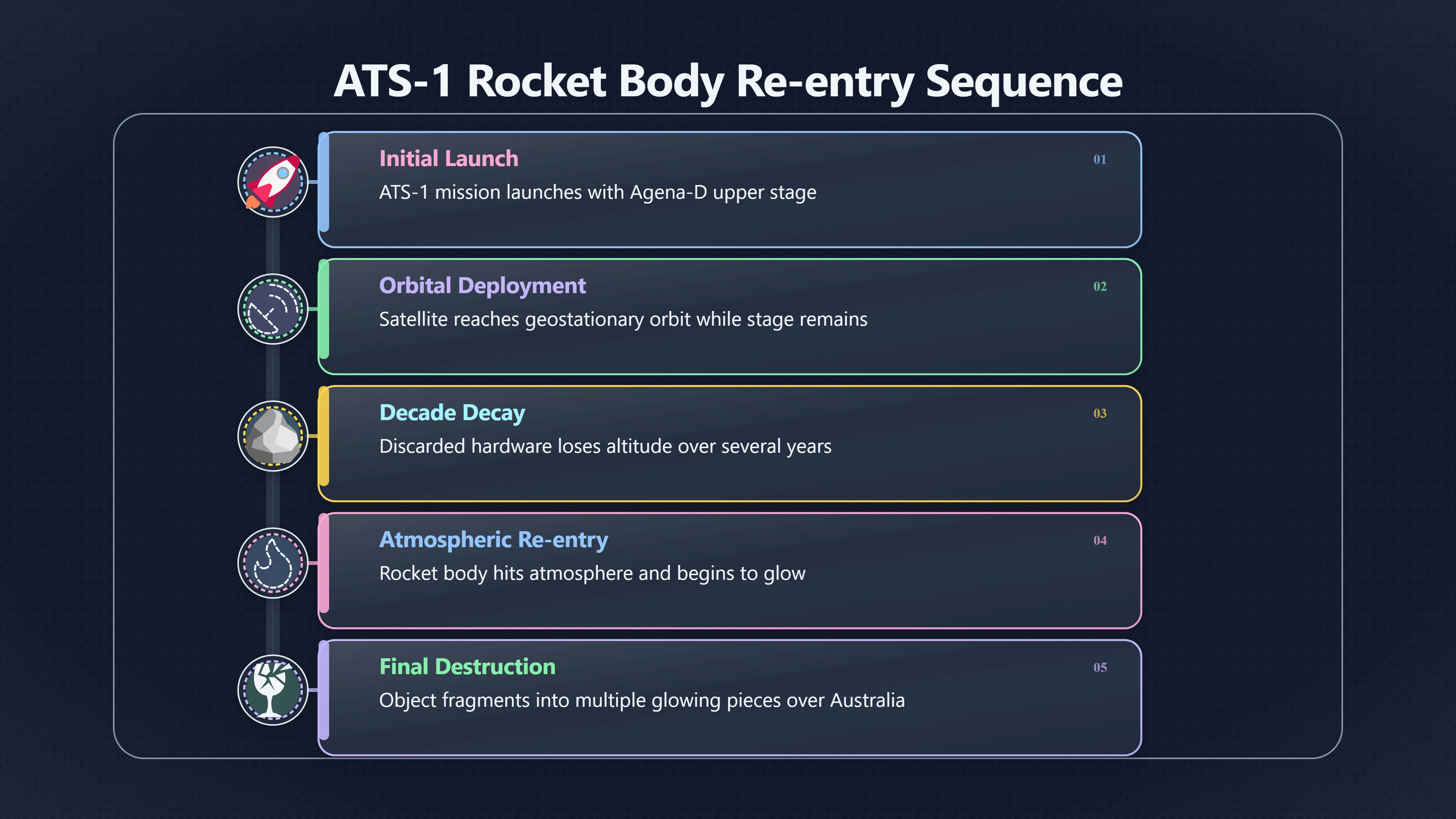
Later re-entry catalogues linked the Katherine lights to a discarded ATS-1 Agena-D rocket body rather than an active satellite.
On this page
- What later re entry catalogues added
- Why ATS 1 means rocket body, not spacecraft
- How re entering debris creates red tailed fragments
Page outline Jump by section
Introduction
The strongest later explanation for the Katherine lights of 15 October 1974 is not an unknown craft, nor even the ATS-1 satellite itself, but the re-entry of the discarded Agena-D rocket body that had launched ATS-1 eight years earlier. This distinction matters because it shows how dramatic UFO reports can arise from ageing space hardware returning to Earth long after a mission has ended.
 When the sighting was first investigated, RAAF personnel could only suggest that some kind of satellite or rocket material was a likely cause. Decades later, improved re-entry catalogues and orbital reconstructions identified a specific object: the Agena-D upper stage associated with the ATS-1 launch, catalogued as object 1966-110B. According to later re-entry compilations, this rocket body decayed over northern Australia at about 10:45 UTC on 15 October 1974, matching reports from Katherine and the Kimberley region remarkably well.[Satellites Observed]satobs.org2609 USA. ATS 1 r. R. Agena D. ~750 Western Australia… (AP), "Russian rocket body re-entry mistaken for meteor shower", Amarillo…Re…
What later re-entry catalogues added
One reason the Katherine case remains important in Northern Territory UFO history is that it demonstrates how later research can clarify events that initially appeared mysterious.
In 1974 investigators did not have access to the detailed historical re-entry databases available today. Contemporary RAAF correspondence pointed generally towards satellite or rocket debris, but did not identify a single confirmed object. The breakthrough came from later cataloguing work by satellite observers and re-entry researchers who reconstructed past orbital decays from tracking data and archival records.[Satellites Observed]satobs.org2609 USA. ATS 1 r. R. Agena D. ~750 Western Australia… (AP), "Russian rocket body re-entry mistaken for meteor shower", Amarillo…Re…
These later catalogues list a visually observed re-entry on 15 October 1974 involving object 1966-110B, described as the ATS-1 rocket body, an Agena-D stage. The catalogue specifically places the observation track over Western Australia locations including Cockatoo Island, Derby and Fitzroy Crossing, and over Katherine in the Northern Territory. The recorded decay time aligns closely with the reported sighting time.[Satellites Observed]satobs.org2609 USA. ATS 1 r. R. Agena D. ~750 Western Australia… (AP), "Russian rocket body re-entry mistaken for meteor shower", Amarillo…Re…
For historians of UFO reports, this is significant because it moves the explanation beyond a generic suggestion of “space debris” and towards a particular piece of hardware with a documented orbital history.
Why ATS-1 means rocket body, not spacecraft
A common misunderstanding is that the Katherine sighting was caused by the ATS-1 satellite itself falling back to Earth.
ATS-1, short for Applications Technology Satellite 1, was a NASA experimental communications and meteorological satellite launched in December 1966. The spacecraft operated in geostationary orbit and became one of the pioneering satellites of the early space age.[Skyrocket.space]space.skyrocket.de1, 3 - Gunter's Space Page11 Jul 2025 — ATS 1 (Applications Technology Satellite) was designed and launched for the purpose of (1) testin…
The object linked to the Katherine event was different. The designation attached to the 1974 re-entry is 1966-110B, which identifies the Agena-D rocket stage used during the launch rather than the ATS-1 spacecraft. After placing the satellite into its intended orbit, the rocket stage remained in space as discarded hardware. Like many upper stages of the era, it eventually lost altitude and re-entered the atmosphere years later.[Satellites Observed]satobs.org2609 USA. ATS 1 r. R. Agena D. ~750 Western Australia… (AP), "Russian rocket body re-entry mistaken for meteor shower", Amarillo…Re…
This distinction helps explain why the sighting occurred so long after the original launch. Witnesses were not seeing an operational satellite returning to Earth after a mission failure. They were most likely witnessing the fiery destruction of a spent launch vehicle component that had been orbiting silently for nearly a decade.[Satellites Observed]satobs.org2609 USA. ATS 1 r. R. Agena D. ~750 Western Australia… (AP), "Russian rocket body re-entry mistaken for meteor shower", Amarillo…Re…

How re-entering debris creates red tailed fragments
The witness descriptions from Katherine fit well with the known appearance of large re-entering rocket bodies.
As a sizeable object plunges into the upper atmosphere at orbital speed, intense friction heats its surface until it glows. Structural components then begin to break apart. Rather than producing a single point of light, the object can fragment into multiple glowing pieces travelling together along the same path.
From the ground, observers often report:
- Several lights instead of one object.
- Red, orange or yellow colours caused by heating and burning materials.
- Long luminous tails or streaks.
- Apparent slow motion compared with an ordinary meteor.
- Fragmentation into separate glowing pieces.
These characteristics closely resemble the Katherine descriptions of reddish lights with tails moving across the sky. The reported group formation is especially consistent with a large rocket body breaking up during atmospheric descent.[Satellites Observed]satobs.org2609 USA. ATS 1 r. R. Agena D. ~750 Western Australia… (AP), "Russian rocket body re-entry mistaken for meteor shower", Amarillo…Re…
The broad geographical spread of the reports also supports a high-altitude re-entry. Objects disintegrating hundreds of kilometres above Earth can be visible across enormous distances, allowing observers in different towns and even different states to witness the same event simultaneously.
How strong is the ATS-1 rocket-body explanation?
No explanation can be considered absolutely proven without direct tracking data tied to the exact observation. Nevertheless, the ATS-1 Agena-D identification is considerably stronger than many retrospective UFO solutions.
Several factors point in the same direction:
- A documented re-entry occurred on the correct date.[Satellites Observed]satobs.org2609 USA. ATS 1 r. R. Agena D. ~750 Western Australia… (AP), "Russian rocket body re-entry mistaken for meteor shower", Amarillo…Re…
- The estimated decay time closely matches the reported sighting window.[Satellites Observed]satobs.org2609 USA. ATS 1 r. R. Agena D. ~750 Western Australia… (AP), "Russian rocket body re-entry mistaken for meteor shower", Amarillo…Re…
- The reconstructed visibility path includes both Katherine and the Kimberley locations that produced reports.[Satellites Observed]satobs.org2609 USA. ATS 1 r. R. Agena D. ~750 Western Australia… (AP), "Russian rocket body re-entry mistaken for meteor shower", Amarillo…Re…
- Witness descriptions of multiple red tailed lights match the expected appearance of a fragmenting rocket stage.[Satellites Observed]satobs.org2609 USA. ATS 1 r. R. Agena D. ~750 Western Australia… (AP), "Russian rocket body re-entry mistaken for meteor shower", Amarillo…Re…
- Contemporary RAAF investigators independently suspected re-entering satellite or rocket material before the specific identification became available.[Satellites Observed]satobs.org2609 USA. ATS 1 r. R. Agena D. ~750 Western Australia… (AP), "Russian rocket body re-entry mistaken for meteor shower", Amarillo…Re…
Taken together, these points have strengthened the ordinary explanation rather than weakened it. Within the wider history of Northern Territory UFO reports, the Katherine case is therefore a useful example of how a striking aerial mystery can become clearer as orbital records improve. What initially appeared to be an unexplained formation of lights is now best understood as the spectacular atmospheric return of a long-abandoned Agena-D rocket stage from the ATS-1 mission.
Amazon book picks
Further Reading
Books and field guides related to Was a dead rocket stage behind the UFO?. Use these as the next step if you want deeper reading beyond the article.
The UFO Experience
Focuses on systematic investigation of sightings, including misidentifications of astronomical and aerospace phenomena.

UFOs : Generals, Pilots, and Government Officials Go on the R...
Provides context for evaluating UFO reports and the role of conventional explanations versus unexplained cases.
Identified Flying Objects
Offers a modern framework for discussing UFO reports while encouraging examination of competing explanations.
Space Junk
Explains rocket bodies, orbital debris, re-entry, and how discarded hardware returns to Earth.
eBay marketplace picks
Marketplace Samples
Live-tested eBay searches with available results related to this page.



Endnotes
1.
Source: space.skyrocket.de
Link:https://space.skyrocket.de/doc_sdat/ats-1.htm
Source snippet
1, 3 - Gunter's Space Page11 Jul 2025 — ATS 1 (Applications Technology Satellite) was designed and launched for the purpose of (1) testin...
2.
Source: ntrs.nasa.gov
Link:https://ntrs.nasa.gov/api/citations/19740027133/downloads/19740027133.pdf
Source snippet
DS Akens · 1974 — The Skylab 11 astronauts successfully completed their m;ssion and, after 84 days in space, returned safely to earth on...
3.
Source: ntrs.nasa.gov
Title: Congress, the. White. House, and the public largely.Read more
Link:https://ntrs.nasa.gov/api/citations/19880016046/downloads/19880016046.pdf
Source snippet
HISTORICAL DATA BOOK Volume illby LN Ezell · 1988 · Cited by 9 — The story of NASA's first decade is one of enthusiasm, competition, grow...
4.
Source: satobs.org
Link:https://www.satobs.org/reentry/Visually_Observed_Natural_Re-entries_latest_draft.pdf
Source snippet
2609 USA. ATS 1 r. R. Agena D. ~750 Western Australia... (AP), "Russian rocket body re-entry mistaken for meteor shower", Amarillo...Re...
Additional References
5.
Source: aerospace.org
Link:https://aerospace.org/reentries/grid?field_reentry_sighting_value=All&field_reentry_type_target_id%5B0%5D=31&field_reentry_type_target_id%5B1%5D=4190&field_reentry_type_target_id%5B2%5D=32&field_reentry_type_target_id%5B3%5D=33&format_select=table&order=title&page=147&reentry_timezone_selector=Europe%2FCopenhagen&sort=asc
Source snippet
ReentriesThe Center for Orbital and Reentry Debris Studies (CORDS) Reentry Database documents objects and payloads that have reentered ea...
6.
Source: planet4589.org
Link:https://planet4589.org/space/reentry/cols.html
7.
Source: nss.org
Title: NAS A’S FIRST 50 YEARS HISTORICAL PERSPECTIVESPage 1
Link:https://nss.org/wp-content/uploads/NASA-First-50-Years-SP4704.pdf
Source snippet
NASA 50th ANNIVERSARY PROCEEDINGS. NASA'S FIRST 50 YEARS. HISTORICAL PERSPECTIVES. Page 2. Library of Congress Cataloging-in-Publication...
8.
Source: youtube.com
Title: Footage shows space junk lighting up the sky above south-east Australia
Link:https://www.youtube.com/watch?v=Ktz4Qj45QwM
Source snippet
Daily Space Debris Reentries: Assessing the Risks to Earth...
9.
Source: youtube.com
Title: Space debris in Melbourne probably from Russian rocket
Link:https://www.youtube.com/watch?v=M8cHzklnXEg
Source snippet
Footage shows space junk lighting up the sky above south-east Australia...
10.
Source: link.springer.com
Link:https://link.springer.com/content/pdf/10.1007/978-94-010-2576-8.pdf
Source snippet
book PDF - Springer NatureSpace scientists and engineers belonging to the professional societies associated with the International Astron...
11.
Source: facebook.com
Link:https://www.facebook.com/groups/spacehipsters/posts/6026818660696300/
Source snippet
Spacecraft launch index from 1957 to 2018Very nice infographics showing every space exploration mission! Crazy to think than in less than...
12.
Source: youtube.com
Title: Daily Space Debris Reentries: Assessing the Risks to Earth
Link:https://www.youtube.com/watch?v=_jqvXhHcRz4
Source snippet
Space Debris Discovered On Australian Farm...
13.
Source: upload.wikimedia.org
Link:https://upload.wikimedia.org/wikipedia/commons/b/bc/RP1357.pdf
Source snippet
Similarly, in 1965, the Apollo program opted for unmanned all- up testing. • Launched atop an N-1 rocket with a L3 lunar lander...R...
14.
Source: youtube.com
Title: Burning Space Debris Lands in Australia!
Link:https://www.youtube.com/watch?v=wQj0060cj1k
Source snippet
Space debris in Melbourne probably from Russian rocket...
Topic Tree