Within Kambah Video
Did the camera create the Kambah disc?
The Kambah footage raises a basic question: did the camera record an object, or did focus and exposure reshape a bright point of light?
On this page
- What the family saw before replaying the tape
- How domestic video cameras distort bright lights
- What evidence is missing from the original footage
Page outline Jump by section
Introduction
The simplest sceptical question about the 1990 Kambah video is also one of the most important: did the tape actually record a disc-shaped object, or did the camera transform a bright point of light into something that looked like a disc when replayed?
 Based on the surviving descriptions, the second possibility cannot be ruled out and is arguably the more technically grounded explanation. Contemporary reports say the family initially noticed a bright object low in the eastern pre-dawn sky and that the videotape later appeared to show a bright circular form with a darker centre and small indentations. Yet the original footage has never been publicly available in a form that allows detailed technical analysis. Without that evidence, it is impossible to know whether the shape on the tape reflected a physical object or a camera artefact created by focus, exposure and zoom behaviour.
What the family saw before replaying the tape
A striking feature of the Kambah case is that the most detailed descriptions of a disc seem to come from the videotape rather than from the initial visual observation.
Accounts published shortly after the event describe the object as first appearing star-like, although unusually bright and apparently larger than an ordinary star. Only after the recording was viewed did attention focus on a more structured appearance, including reports of a bright circular form with a darker centre.
That distinction matters. Human observers and cameras do not necessarily record the same thing. A witness may see a bright light, while a video camera converts that light into a larger geometric shape because of optical and electronic limitations. In many UFO cases involving stars, planets or distant lights, the recorded image becomes the centre of discussion even though the camera is revealing more about its own behaviour than about the object being filmed.
The Kambah case therefore hinges on a mechanism question rather than a witness-credibility question: if the object was effectively a bright point source at a great distance, could a consumer video camera of 1990 have produced a disc-like image on its own?
How domestic video cameras distort bright lights
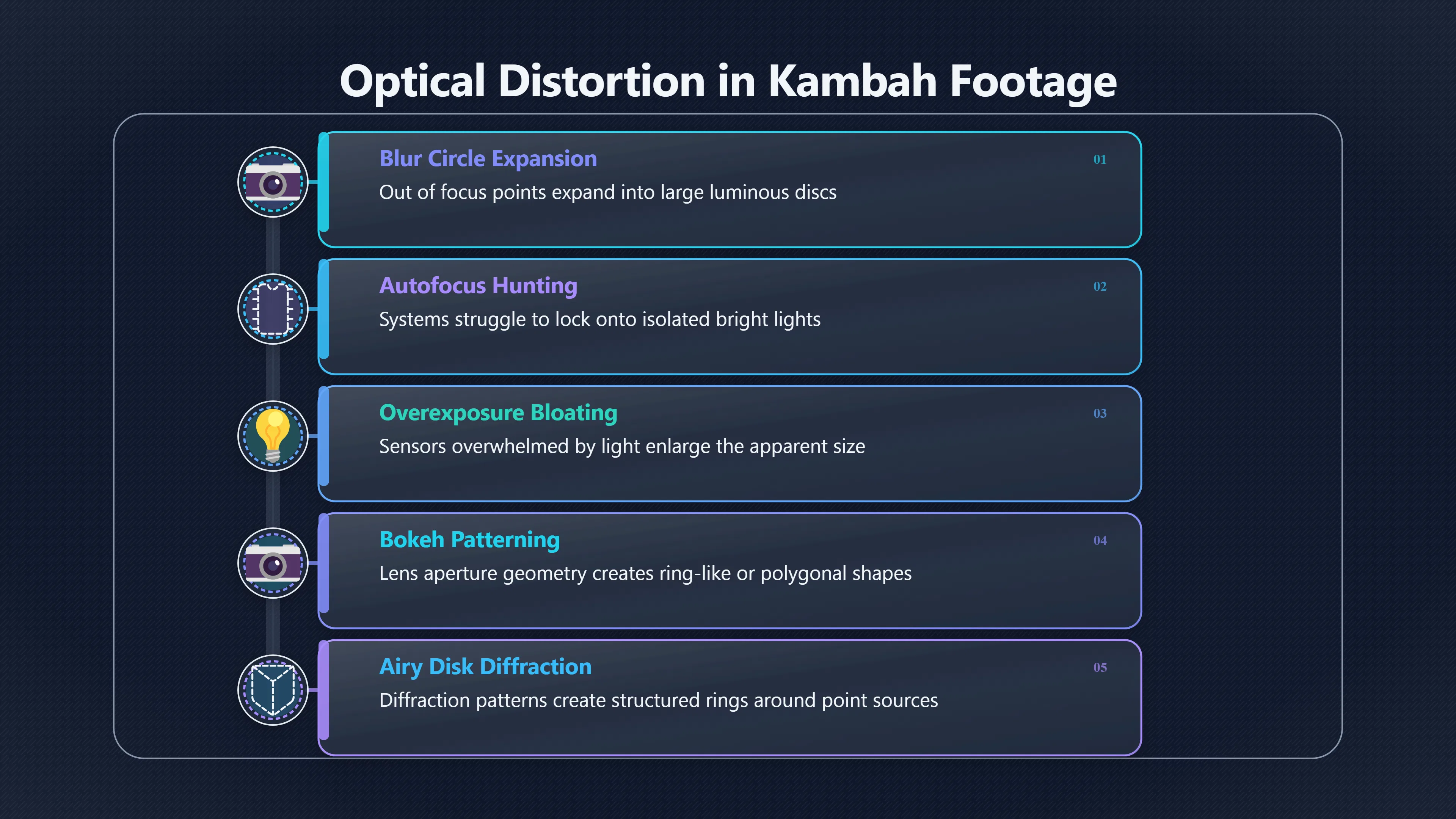
The answer is yes. Several well-understood optical effects can turn a point of light into a larger shape on video.
First, an out-of-focus point source does not remain a point. In optics, a point of light recorded away from perfect focus expands into a “blur circle” or disc. Astronomers routinely use bright stars for focusing because a defocused star becomes a large luminous circle whose size changes as focus is adjusted.[astropix.com]astropix.comOpen source on astropix.com.
Second, autofocus systems often struggle with isolated bright lights against dark backgrounds. Early consumer video cameras commonly searched for contrast when focusing. A single bright object in a largely dark dawn sky provided very little detail for the camera to lock onto, increasing the chance of imperfect focus or repeated focus hunting.[Wikipedia]WikipediaOpen source on wikipedia.org.
Third, overexposure can enlarge bright objects. When a camera sensor or recording system is overwhelmed by a bright light, the recorded image can appear much larger than the true angular size of the source. Defocus and overexposure together can create the impression of a structured object where only a bright point existed.[Wikipedia]WikipediaDefocus aberrationDefocus aberration
These effects are especially relevant because the Kambah sighting reportedly occurred before sunrise. A bright astronomical object viewed in a dim sky creates exactly the sort of high-contrast scene that can challenge autofocus and exposure systems.
Could a dark centre appear without a real object?
The reported “bright circle with a dark centre” is often treated as evidence that the camera captured structure. In reality, such patterns can arise from optical behaviour.
When a bright point source is defocused, the lens aperture can influence the appearance of the resulting blur disc. Out-of-focus points frequently take on shapes related to the optical system rather than the object itself. Photographers know this effect through “bokeh” patterns, where distant lights become circles, polygons or even ring-like forms depending on lens design and aperture geometry.[Wikipedia]WikipediaOpen source on wikipedia.org.
Similarly, optical systems can produce central brightening, edge brightening, rings and other apparent structure that does not correspond to the true shape of the source. Astronomers regularly observe large discs and ring-like forms when stars are intentionally or unintentionally taken out of focus.[stargazerslounge.com]stargazerslounge.comStargazers Lounge Airy disks, diffraction theory, and out of focus starsStargazers LoungeAiry disks, diffraction theory, and out of focus starsOctober 12, 2013 — 12 Oct 2013 — The larger/ smaller disks of ligh…
This does not prove that the Kambah object was a star. It does show, however, that a dark-centred or ring-like appearance on a videotape is not by itself evidence of a solid disc-shaped craft.

What evidence is missing from the original footage
The strongest argument against drawing firm conclusions from the tape is not that a conventional explanation is certain. It is that crucial evidence is absent.
To evaluate whether the camera created the apparent disc, investigators would ideally need:
- The original first-generation recording rather than later copies.
- Information about the camera model, lens and zoom setting.
- Knowledge of whether autofocus was enabled.
- The complete unedited sequence, including moments before and after the most dramatic frames.
- Frame-by-frame analysis showing whether the shape changed as zoom or focus changed.
- Independent astronomical reconstruction of what bright celestial objects were visible in the eastern Canberra sky at the reported time.
Without those details, it is difficult to separate the appearance of the recorded image from the characteristics of the recording system itself.
This gap is important because many apparently unusual video images become less mysterious when investigators can track how the shape changes with focus, magnification or exposure. In the Kambah case, the publicly available record is too limited to perform that kind of reconstruction.

Why the camera explanation remains plausible
Within the broader history of ACT UFO reports, the Kambah video is often remembered because it seemed to provide visual evidence. Yet visual evidence is only as strong as the conditions under which it was recorded.
The key facts that support a camera-generated appearance are straightforward:
- The object was reported in the eastern pre-dawn sky, where bright astronomical objects are plausible candidates.
- Witnesses reportedly compared it to a star before focusing on the videotape image.
- The disc-like appearance appears to have emerged primarily through replay and interpretation of the recording.
- Consumer video cameras of the period were capable of turning bright point sources into large circular or structured-looking images through defocus and exposure effects.[astropix.com]astropix.comOpen source on astropix.com.
- No publicly available technical analysis of the original recording has demonstrated that the apparent shape represented a physical structure rather than an optical artefact.
For that reason, the “camera-created disc” explanation remains one of the most plausible interpretations of the Kambah footage. It does not conclusively identify the original light, nor does it prove that the family misidentified what they saw. It simply reflects the fact that the recorded shape is weaker evidence than it first appears. In the absence of the original tape and detailed technical data, the disc remains as much a question about the limitations of early home video technology as it is about anything that may have been in the Canberra sky.
Amazon book picks
Further Reading
Books and field guides related to Did the camera create the Kambah disc?. Use these as the next step if you want deeper reading beyond the article.
The UFO Experience
Provides a scientific framework for evaluating UFO reports and the quality of evidence behind unusual sightings.
Bad Astronomy
Covers common misunderstandings involving astronomical observations and misidentified lights in the sky.

UFOs : Generals, Pilots, and Government Officials Go on the R...
Explores standards of evidence and documentation relevant to assessing recorded UFO claims.
Digital Video and HD
Helps explain how cameras, sensors, exposure, and image processing can alter the appearance of bright objects.
eBay marketplace picks
Marketplace Samples
Live-tested eBay searches with available results related to this page.


Endnotes
1.
Source: astropix.com
Link:https://www.astropix.com/html/astrophotography/focus_methods.html
2.
Source: Wikipedia
Link:https://en.wikipedia.org/wiki/Autofocus
3.
Source: Wikipedia
Title: Defocus aberration
Link:https://en.wikipedia.org/wiki/Defocus_aberration
4.
Source: Wikipedia
Link:https://en.wikipedia.org/wiki/Bokeh
5.
Source: Wikipedia
Title: Airy disk
Link:https://en.wikipedia.org/wiki/Airy_disk
6.
Source: cloudynights.com
Title: Cloudy Nights CMOS camera question
Link:https://www.cloudynights.com/forums/topic/594009-cmos-camera-question/
Source snippet
With a very bright star, even if you are out of focus, you will usually be able to see a big bright disc for the star...
7.
Source: stargazerslounge.com
Title: Stargazers Lounge Airy disks, diffraction theory, and out of focus stars
Link:https://stargazerslounge.com/topic/196927-airy-disks-diffraction-theory-and-out-of-focus-stars/
Source snippet
Stargazers LoungeAiry disks, diffraction theory, and out of focus starsOctober 12, 2013 — 12 Oct 2013 — The larger/ smaller disks of ligh...
Published: October 12, 2013
Additional References
8.
Source: nighttime-imaging.eu
Link:https://nighttime-imaging.eu/docs/master/site/advanced/autofocus/
Source snippet
Auto-FocusPoor focus will yield softer images and lower SNR. As such it is common for imagers to focus with precision tools such as a Bah...
9.
Source: reddit.com
Link:https://www.reddit.com/r/AskAstrophotography/comments/13qm8el/focus_or_optics_problem_with_refractor/
Source snippet
Focus or optics problem with refractor[https://imgur.com/a/3ltVinH](https://imgur.com/a/3ltVinH) I drove a couple hours to a dark site and there were a few rough spots...
10.
Source: reddit.com
Link:https://www.reddit.com/r/UFOs/comments/1t7de89/from_the_department_of_wars_release_today_this/
Source snippet
Pentagon releases video of a UFO resembling an eight-pointed star... r/UFOs - Very bright light (not where any star should be in that...
11.
Source: facebook.com
Link:https://www.facebook.com/groups/seestar/posts/619863904159229/
Source snippet
rt of imaging with the IR Cut filter, I noticed the stars appeared...
12.
Source: youtube.com
Title: You Tube In-depth look at FOCUS and ASTROPHOTO
Link:https://www.youtube.com/watch?v=tMNGoWOLWTU
Source snippet
In-depth look at FOCUS and ASTROPHOTO - and how to tune itThe camera is searching for the point in its focus range where it has the most...
13.
Source: lonelyspeck.com
Title: focusing at night
Link:https://www.lonelyspeck.com/focusing-at-night/
Source snippet
A Tutorial17 Nov 2015 — Out of focus stars will obviously appear softer but they will also tend to show a little more more color, sometim...
14.
Source: youtube.com
Title: Every Pentagon UFO Video Explained
Link:https://www.youtube.com/watch?v=d_-yNBQfP84
Source snippet
I Solved the Pentagon's 8 Pointed Star UFO | 25 Videos Raw Footage...
15.
Source: youtube.com
Title: Aperture, Bokeh, and Starbursts
Link:https://www.youtube.com/watch?v=c01AoBdB3pk
Source snippet
Mick West out of focus star UFO disc Explained: New Navy UFO Videos Mick West...
16.
Source: youtube.com
Title: I Solved the Pentagon’s 8 Pointed Star UFO | 25 Videos Raw Footage
Link:https://www.youtube.com/watch?v=XIRu_a7-WgY
Source snippet
Explained: New Navy UFO Videos...
17.
Source: youtu.be
Title: Beer Biceps
Link:https://youtu.be/_ziODBruqdA?si=fhyYYkp7QL-Uivrb
Source snippet
INSANE UFO Sighting Just Released 🛸 #ufo #aliens #fyp SKizzle...
Topic Tree