Within TUFOIC
How Small Newsletters Saved Tasmanian Reports
TUFOIC's newsletters and annuals reveal how small civilian groups converted scattered local reports into a traceable Tasmanian record.
On this page
- From witness call to newsletter item
- Annuals, catalogues and retyped case summaries
- Why fragile local newsletters needed wider archives
Page outline Jump by section
Introduction
The most important thing TUFOIC’s newsletters achieved was not proving that any Tasmanian UFO sighting was extraordinary. Their real achievement was turning isolated reports into a record that could be checked, compared and preserved. Before online databases, many sightings existed only as a telephone call, a letter to a newspaper, or a story passed between friends. Once those accounts were entered into a TUFOIC newsletter, they gained a date, a location, a witness description and a place within a growing archive. Over time, hundreds of small entries accumulated into one of Tasmania’s most significant civilian collections of UFO reporting.[Wikipedia]WikipediaAustralian ufologyMay 16, 2025 —… UFO And Phenomena. 1970s. edit. In late 1970, Tasmania UFO Investigation Centre (TUFOIC) produced the Tasmanian UFO Re…
 For historians of Tasmanian UFO reports, the newsletters matter because they show the process by which sightings moved from private memory into a documented record. They reveal how a small volunteer organisation created continuity across decades of reports that might otherwise have disappeared.
From witness call to newsletter item
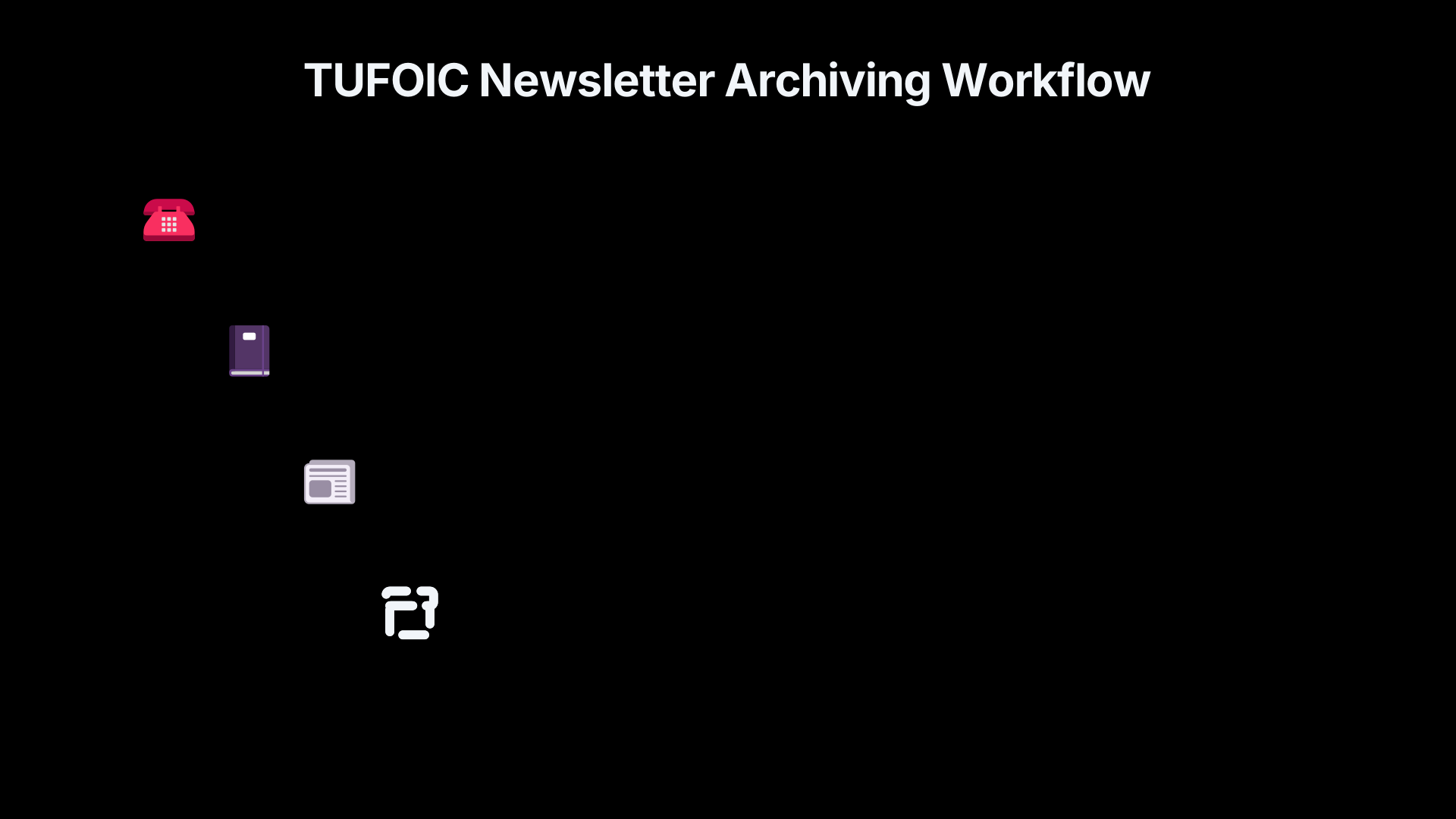
A typical report often began with a witness contacting TUFOIC directly, responding to publicity, or having a sighting forwarded by another researcher. The challenge for investigators was not simply collecting stories but preserving enough detail for future review.
The newsletter format provided a practical solution. Even brief entries could record:
- Date and time of the observation.
- Location within Tasmania.
- Number of witnesses.
- Description of lights, objects or movements.
- Initial investigative comments.
- Possible conventional explanations where known.
By publishing reports soon after they were received, TUFOIC created a time-stamped trail. Later researchers could see not only what was reported but when it entered the record. This was particularly valuable during periods when multiple sightings were reported across Tasmania, because investigators could compare accounts rather than treat each one as an isolated mystery.[Policy Commons]policycommons.nettufoic newsletter no 066 june 1992 undefinedPolicy CommonsTUFOIC Newsletter No 066 June 1992 undefinedThis newsletter from the Tasmanian UFO Investigation Centre (TUFOIC) summarizes…
The newsletters also acted as a feedback mechanism. Readers occasionally recognised similar events, supplied additional information or suggested explanations. In that sense, publication was part of the investigation process rather than merely a final report.
Annuals, catalogues and retyped case summaries
As the number of reports increased, newsletters alone were not enough. Information had to be organised so that older cases could still be found.
Evidence from Australian UFO-history sources indicates that TUFOIC began publishing the Tasmanian UFO Report in 1970, later continuing as the TUFOIC Newsletter, which ultimately ran for many decades and dozens of issues. Histories of Australian ufology commonly describe a long publication run extending from 1970 into the late twentieth century.[Wikipedia]WikipediaAustralian ufologyMay 16, 2025 —… UFO And Phenomena. 1970s. edit. In late 1970, Tasmania UFO Investigation Centre (TUFOIC) produced the Tasmanian UFO Re…
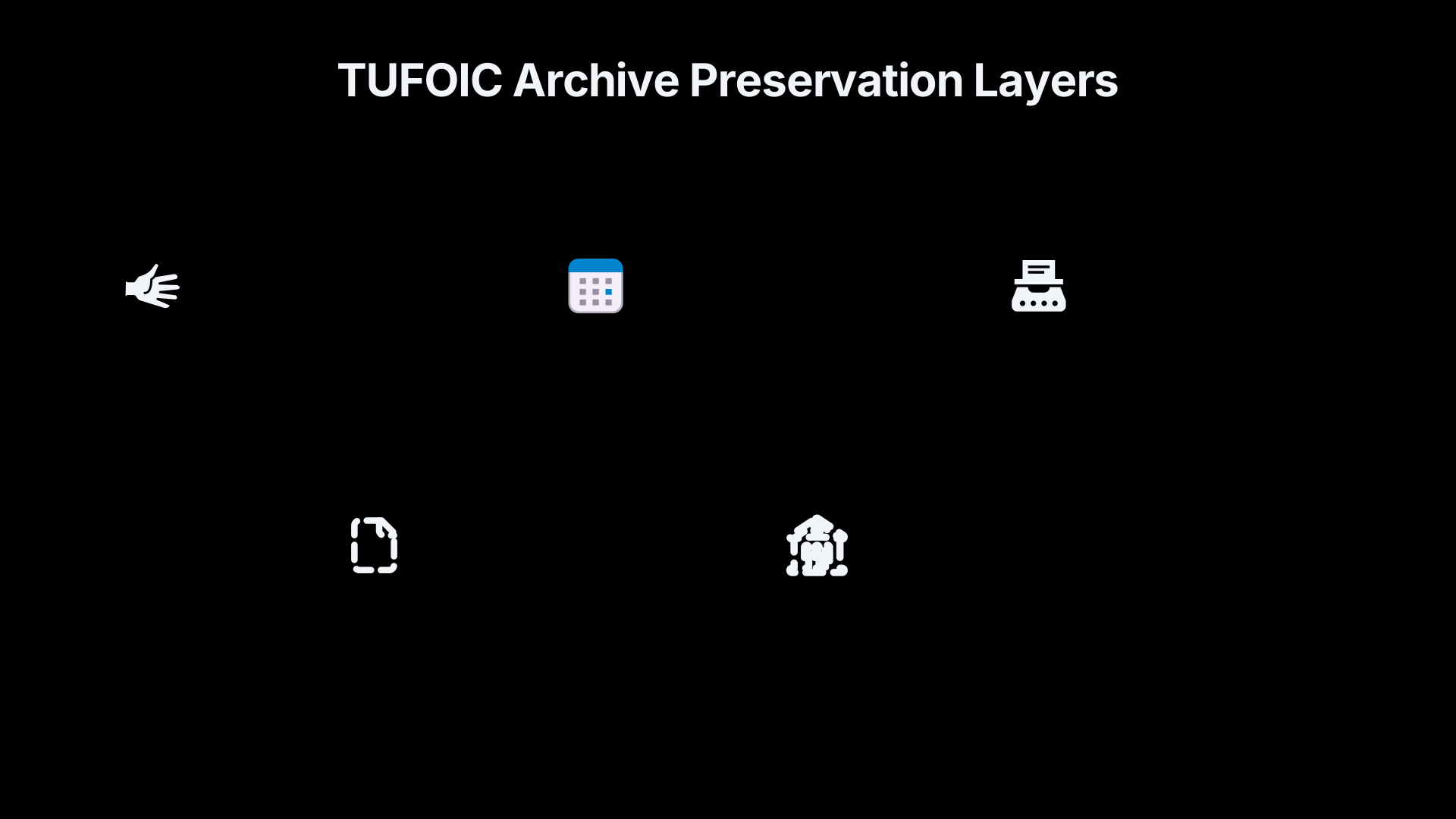
This continuity allowed several layers of archiving to develop:
Newsletter reports. These preserved contemporary sightings close to the time they were reported.
Annual summaries. Cases from a given period could be grouped and reviewed together, making trends easier to spot.
Retyped historical reports. Older newspaper accounts and earlier investigations were often rewritten into a consistent format, allowing comparisons between events separated by decades.
Case catalogues. Basic information such as dates, places and witness details could be indexed, creating a searchable reference system long before digital databases became common.
The result was cumulative. A sighting from a small Tasmanian town might first appear as a short newsletter note. Years later it could be incorporated into an annual review. Decades after that, it might appear again in a historical compilation. Each step reduced the risk that the original report would be lost.
This layered approach is visible in later TUFOIC publications. Keith Roberts’ Tasmania: A UFO History assembled historical reports, newspaper clippings, sketches and case summaries stretching back into the nineteenth century, demonstrating how earlier newsletter material had been preserved and reused rather than forgotten. National Library of Australia Catalogue+2UFOs Scientific Research[catalogue.nla.gov.au]catalogue.nla.gov.auRequest Order a copy… Hobart: Tasmanian UFO Investigation Centre, 2011; 76 p.: ill. (some col…Read more…
Why the newsletters became more valuable with age
At the time they were produced, many newsletters were inexpensive photocopied publications intended for a relatively small readership. Their creators were usually concerned with sharing information quickly, not creating a permanent historical archive.
Ironically, that temporary nature is what makes surviving copies valuable today.
Local newspapers often condensed reports or focused on dramatic details. Witnesses moved away, died or forgot specifics. Personal notes could be discarded. The newsletters frequently became the only surviving source showing how a case was originally described at the time.
Because the publications were produced continuously over many years, they also allow researchers to reconstruct patterns. Rather than examining only famous incidents, historians can see ordinary reports, false alarms, unresolved observations and recurring explanations side by side. This broader picture helps avoid the distortion that occurs when only the most sensational cases survive.
The newsletters therefore preserve reporting history as much as sighting history. They document what Tasmanians thought they saw, what investigators recorded, and how interpretations changed over time.
Why fragile local newsletters needed wider archives
The greatest weakness of newsletter-based archives was their vulnerability. Small print runs meant that many copies were easily lost. A collection held by a single researcher could disappear through neglect, relocation or estate dispersal.
For that reason, wider archival preservation became essential. TUFOIC material eventually reached larger repositories and collections beyond Tasmania. Copies of newsletters have been preserved by specialist UFO archives, while later TUFOIC publications entered institutional catalogues such as the National Library of Australia. Surviving issues have also been digitised by archival projects, making material that was once available only to a handful of subscribers accessible to researchers around the world. Internet Archive+2National Library of Australia Catalogue[archive.org]archive.orgTUFOIC Newsletter No 097 February 2005Internet ArchiveTUFOIC Newsletter No 097 February 200515 Oct 2019 — TUFOIC Newsletter No 097 February 2005; Publication date: 2005; Top…
This migration from photocopied newsletter to library catalogue illustrates the larger significance of TUFOIC’s work. The organisation did not create a modern database from the outset. Instead, it built an archive gradually through repeated acts of documentation: recording a witness account, printing a newsletter item, compiling annual summaries and preserving older reports.
What the newsletters tell us about Tasmania’s UFO record
The lasting value of TUFOIC’s newsletters lies in their ability to connect scattered observations across time. They transformed fleeting local stories into a traceable documentary trail. That does not make the reports verified, nor does it resolve debates about individual sightings. Many cases remain weakly documented, disputed or susceptible to conventional explanations.
What the newsletters do provide is continuity. Without them, many Tasmanian sightings would survive only as rumours or brief newspaper references. With them, researchers can follow how reports were received, investigated, summarised and remembered. In the history of Tasmania’s civilian UFO archives, that quiet record-keeping role may be more important than any single sighting preserved within it.

Amazon book picks
Further Reading
Books and field guides related to How Small Newsletters Saved Tasmanian Reports. Use these as the next step if you want deeper reading beyond the article.
The UFO Encyclopedia
Matches the page's emphasis on preserving reports, cataloguing cases, and building long-term archives.
The Report on Unidentified Flying Objects
Illustrates how sightings move from witness reports into organized records and investigations.

UFOs : Generals, Pilots, and Government Officials Go on the R...
Focuses on documented reports and source-based investigation rather than sensationalism.
The UFO Experience
Explains case collection, classification, and evaluation of witness reports.
eBay marketplace picks
Marketplace Samples
Live-tested eBay searches with available results related to this page.



Endnotes
1.
Source: Wikipedia
Title: Australian ufology
Link:https://en.wikipedia.org/wiki/Australian_ufology
Source snippet
May 16, 2025 —... UFO And Phenomena. 1970s. edit. In late 1970, Tasmania UFO Investigation Centre (TUFOIC) produced the Tasmanian UFO Re...
Published: May 16, 2025
2.
Source: archive.org
Title: TUFOIC Newsletter No 097 February 2005
Link:https://archive.org/details/TUFOIC_Newsletter_No_097_February_2005
Source snippet
Internet ArchiveTUFOIC Newsletter No 097 February 200515 Oct 2019 — TUFOIC Newsletter No 097 February 2005; Publication date: 2005; Top...
Published: February 2005
3.
Source: catalogue.nla.gov.au
Link:https://catalogue.nla.gov.au/catalog/6150730
Source snippet
Request Order a copy... Hobart: Tasmanian UFO Investigation Centre, 2011; 76 p.: ill. (some col...Read more...
4.
Source: policycommons.net
Title: tufoic newsletter no 066 june 1992 undefined
Link:https://policycommons.net/artifacts/21884693/tufoic-newsletter-no-066-june-1992-undefined/22784881/
Source snippet
Policy CommonsTUFOIC Newsletter No 066 June 1992 undefinedThis newsletter from the Tasmanian UFO Investigation Centre (TUFOIC) summarizes...
Published: june 1992
5.
Source: ufos-scientificresearch.blogspot.com
Title: UFOs Scientific Research Tasmania
Link:https://ufos-scientificresearch.blogspot.com/2013/01/tasmania-ufo-history.html
Source snippet
Tasmania - a UFO history18 Jan 2013 — Hi all, The Tasmanian UFO Investigation Centre (TUFOIC) has recently produced a new 77 page publica...
Additional References
6.
Source: facebook.com
Link:https://www.facebook.com/groups/auroraaustralis/posts/24527287733546112/
Source snippet
UFO sighting in southern Tasmania?UFOs in Australia As depicted in the art and petroglyphs of the Aboriginal people, UFO and alien sighti...
7.
Source: shop.fullersbookshop.com.au
Link:https://shop.fullersbookshop.com.au/p/tasmania-a-ufo-history
Source snippet
A UFO History: TASUFO; Publisher: tufoic; Product Type: books. Special Fields. Author: Keith Roberts. In recognition of the deep histo...
8.
Source: facebook.com
Link:https://www.facebook.com/ABCiview/videos/ufos-in-australia-arj-barker-investigates-australia-talks-monday-21-june-8pm-on-/562449445137971/
9.
Source: facebook.com
Link:https://www.facebook.com/flightfacilities/posts/ufo-sightings-were-at-an-all-time-high-last-night-tasmania-you-were-amazing-as-a/748555269960318/
10.
Source: facebook.com
Title: yet more australian pdfs 95 issues of tufoic tasmanian ufo investigation centre
Link:https://www.facebook.com/isaac.koi/posts/yet-more-australian-pdfs-95-issues-of-tufoic-tasmanian-ufo-investigation-centre-/10211875296867448/
Source snippet
95 issues of TUFOIC [Tasmanian UFO Investigation Centre...4 Oct 2018 — Yet more Australian PDFs - 95 issues of TUFOIC [Tasmanian UFO Inv...
11.
Source: scribd.com
Link:https://www.scribd.com/document/492616223/Australian-UFO-Magazine
Source snippet
25 pages. UFO Sightings and Reports Overview. PDF. No ratings yet. UFO Sightings and Reports Overview. 7 pages.Read more...
12.
Source: academia.edu
Link:https://www.academia.edu/69518005/Proceedings_of_the_Sign_Historical_Group_UFO_History_Workshop
Source snippet
ence, less well known, stretching back to the sixteenth century.Read more...
13.
Source: scribd.com
Title: Catalog for Collectors UFO Newsletters 2023
Link:https://www.scribd.com/document/729071349/Catalog-for-Collectors-UFO-Newsletters-2023
Source snippet
UFO Newsletter Collector's Catalog 2023 | PDF3 May 2024 — The document appears to be a catalog listing UFO newsletters from various count...
Published: May 2024
14.
Source: youtube.com
Link:https://www.youtube.com/watch?v=nZ6s2NmySbs
Source snippet
In the 80s the RAAF held hundreds of files documenting UFO sightings 🛸 | Uncropped | ABC Australia...
15.
Source: ignaciodarnaude.es
Title: AF U Serials Archive by Country and Title
Link:https://ignaciodarnaude.es/wp-content/uploads/2025/08/Rev.UFO-Journals-List.pdf
Source snippet
UFO Newsletter. 1. 1970. 2=May/June, 3=July/Aug. Editor: G Aldunati. 2. Aurora (El Grupo Aurora). 1. Mayo. 199? Editor: P Warmkraut. 1. B...
Topic Tree