Within TUFOIC
When TUFOIC Found Ordinary Answers
TUFOIC's report sorting matters because balloons, satellites, astronomy and even mollusc eggs often explained claims that first sounded strange.
On this page
- The 2014 report categories and what they show
- The 1996 UFO slime case as a cautionary example
- Why mundane explanations strengthen an archive
Page outline Jump by section
Introduction
One of the most useful features of the Tasmania UFO Investigation Centre (TUFOIC) archive is that it did not treat every strange report as an enduring mystery. By the 2010s, TUFOIC was explicitly sorting reports into categories that distinguished between cases with likely explanations, cases lacking enough information, and a smaller number that remained unresolved. That approach matters because a civilian archive becomes more valuable, not less, when it records ordinary explanations alongside unusual claims.
 For readers exploring Tasmania’s UFO history, the lesson is straightforward: many reports that initially sound extraordinary later turn out to involve balloons, satellites, astronomical objects, aircraft, misperceptions or biological materials. The archive’s importance lies in documenting that process of investigation rather than simply collecting mysteries. In that sense, TUFOIC’s classifications help show how UFO research can separate unexplained reports from reports that only appeared unexplained at first glance.[National Library of Australia Catalogue]catalogue.nla.gov.auAlso Titled: Tasmania: a unidentified flying object history; Copyright: In Copyright. You may copy under some circumstances…Read more…
The 2014 report categories and what they show
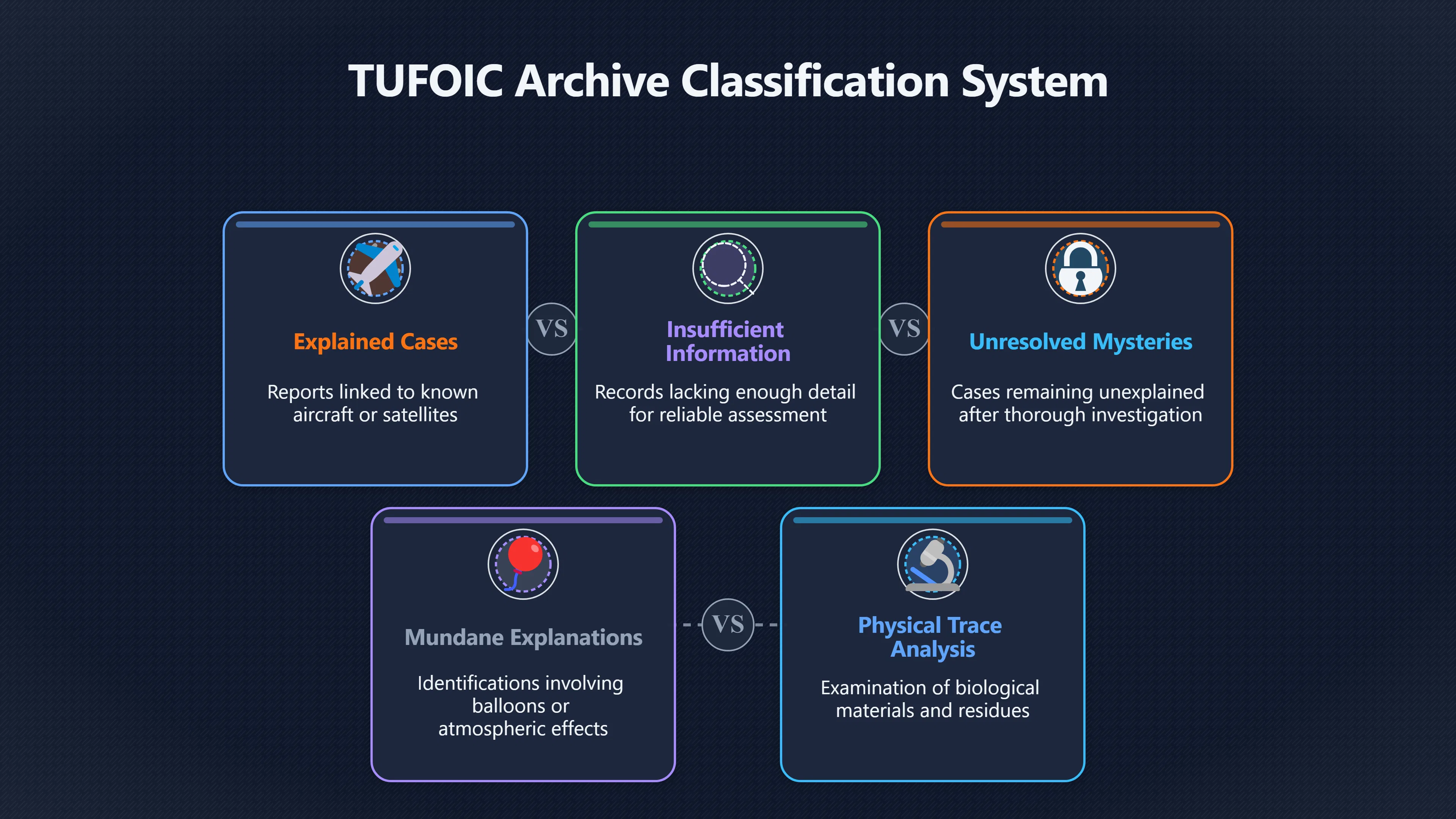
A recurring problem in UFO research is that the term “unidentified” is often used for two very different situations. One is a genuinely unresolved report after investigation. The other is a report that simply lacks enough information to reach any conclusion.
TUFOIC’s later reporting reflected this distinction. Cases were not automatically placed into a single basket labelled “UFO”. Instead, reports could be assessed according to whether they appeared explained, insufficiently documented, or still unresolved after examination. This mirrors a long-established approach used in official and civilian UFO studies internationally, where investigators separate identified objects, insufficient-information cases and unknowns rather than treating them as equivalent categories.[Wikipedia]WikipediaIdentification studies of UFOsIdentification studies of UFOs
For Tasmania’s archive, that distinction is important because many reports eventually pointed towards ordinary causes such as:
- Bright planets, stars or other astronomical objects.
- Satellites and space-related observations.
- Aircraft, helicopters and aviation lights.
- Balloons and airborne debris.
- Atmospheric effects and unusual lighting conditions.
- Reports where too little information survived for a reliable assessment.
The practical result is that an archive containing many explained reports is not evidence that witnesses were dishonest. Quite the opposite. Most witnesses appear to have reported what they genuinely saw. The investigation comes later, when additional information allows an object or phenomenon to be identified. This pattern is common across UFO research and helps explain why archives often contain far more solved cases than enduring mysteries.[Wikipedia]WikipediaIdentification studies of UFOsIdentification studies of UFOs
Why “insufficient information” matters
One of the most overlooked categories in UFO archives is the report that cannot be properly assessed because key details are missing.
A witness may remember a bright light but not the direction, duration, weather conditions or exact date. A newspaper clipping may describe an event but omit crucial observational details. In those circumstances, classifying a report as unresolved would be misleading. A more honest conclusion is that there is not enough evidence to know.
This may sound unexciting, but it improves the quality of the archive. By separating weakly documented reports from stronger cases, investigators reduce the risk of turning incomplete stories into permanent mysteries. The distinction has been recognised in major UFO identification studies for decades and remains relevant when reviewing Tasmania’s historical reports.[Wikipedia]WikipediaIdentification studies of UFOsIdentification studies of UFOs
The 1996 UFO slime case as a cautionary example
One of the more memorable examples discussed in TUFOIC material involved a 1996 report of alleged “UFO slime”. Such cases are attractive because they appear to offer physical evidence rather than a fleeting observation in the sky.
The difficulty is that unusual material found on the ground does not automatically have any connection to an aerial phenomenon. Investigations of supposed UFO residues around the world have repeatedly shown that ordinary biological or environmental materials can be mistaken for something exotic. In the Tasmanian example, the material was ultimately linked to a mundane biological explanation involving mollusc eggs rather than evidence of a spacecraft or unknown technology.[Policy Commons]policycommons.nettufoic newsletter no 079 october 1996 undefinedPolicy CommonsTUFOIC Newsletter No 079 October 1996 undefinedThis TUFOIC Newsletter from October 1996 reports on increased UFO sightings…
The significance of the case is not the material itself. It is the way the explanation changed the interpretation of the event.
At first glance, an unfamiliar gelatinous substance may seem highly unusual. Once biological identification becomes available, the mystery largely disappears. The object of interest remains real, but the explanation changes completely.
That makes the 1996 case a useful reminder that the strangeness of an observation and the strength of an extraterrestrial interpretation are not the same thing. A witness can accurately describe something genuinely odd while still being mistaken about its origin.
A wider lesson from physical-trace claims
Physical-trace cases often receive disproportionate attention because they appear more tangible than eyewitness testimony. Yet they also demonstrate why careful classification matters.
Without follow-up investigation, a biological sample can become a UFO artefact. With investigation, it may become a documented example of misidentification. The archive becomes stronger when it preserves both stages of the story rather than only the sensational first report.

Why mundane explanations strengthen an archive
To some enthusiasts, explaining reports away might seem to weaken the significance of a UFO archive. In practice, the opposite is usually true.
An archive that records only unexplained cases creates a distorted picture because it hides the investigative process. An archive that preserves solved cases, probable explanations and failed hypotheses allows readers to see how conclusions were reached.
This approach offers several advantages:
It improves credibility. When investigators are willing to accept ordinary explanations, readers have more reason to trust their handling of genuinely puzzling cases.
It reveals recurring patterns. Repeated identifications involving satellites, astronomy, balloons or aircraft help explain why similar reports continue to appear in different years and locations.
It prevents myth-building. Cases that sound extraordinary in early newspaper coverage can become legends if later explanations are forgotten. Keeping the explanatory record attached to the original report reduces this problem.
It helps future researchers. Later investigators can compare new reports against previously solved examples rather than starting from scratch every time.
These benefits help explain why classification systems remain central to serious UFO investigation. The goal is not simply to collect mysteries but to understand what people reported and what the available evidence supports.[Wikipedia]WikipediaIdentification studies of UFOsIdentification studies of UFOs
What the classifications tell us about Tasmania’s UFO record
Viewed through TUFOIC’s classifications, Tasmania’s civilian archive becomes less a catalogue of unexplained phenomena and more a record of investigation.
Some reports remain unresolved. Some are too poorly documented to assess. Many acquire ordinary explanations after further checking. The value of the archive lies in preserving all three outcomes.
That is why the most important lesson from TUFOIC’s classification system is not that Tasmania produced a certain number of unexplained sightings. It is that careful investigation often reduced apparently mysterious reports to identifiable causes. Cases involving satellites, astronomy, balloons and even mollusc eggs show that unusual appearances can emerge from entirely ordinary sources. Recording those solutions makes the remaining unresolved reports easier—not harder—to evaluate.[policycommons.net]policycommons.nettufoic newsletter no 079 october 1996 undefinedPolicy CommonsTUFOIC Newsletter No 079 October 1996 undefinedThis TUFOIC Newsletter from October 1996 reports on increased UFO sightings…
Amazon book picks
Further Reading
Books and field guides related to When TUFOIC Found Ordinary Answers. Use these as the next step if you want deeper reading beyond the article.
The Demon-Haunted World
Rating: 4.5/5 from 43 Google Books ratings
Strongly matches the article's theme that careful investigation and ordinary explanations improve understanding.
UFOs, Chemtrails, and Aliens
Focuses on scientific explanations for UFO reports and other anomalous claims.
UFOs
Provides a balanced entry into UFO case evaluation and evidence assessment rather than pure sensationalism.
Bad UFOs
Directly examines how seemingly mysterious UFO reports often acquire ordinary explanations after investigation.
eBay marketplace picks
Marketplace Samples
Live-tested eBay searches with available results related to this page.


Endnotes
1.
Source: Wikipedia
Title: Unidentified flying object
Link:https://en.wikipedia.org/wiki/Unidentified_flying_object
2.
Source: Wikipedia
Title: Identification studies of UFOs
Link:https://en.wikipedia.org/wiki/Identification_studies_of_UFOs
3.
Source: Wikipedia
Title: List of reported UFO sightings
Link:https://en.wikipedia.org/wiki/List_of_reported_UFO_sightings
Source snippet
List of reported UFO sightingsThis is a list of notable reported sightings of unidentified flying objects (UFOs) some of which include...
4.
Source: Wikipedia
Title: Varginha UFO incident
Link:https://en.wikipedia.org/wiki/Varginha_UFO_incident
Source snippet
Varginha UFO incidentThe Varginha UFO incident involves a series of events in 1996 when residents... case considered unassailable pro...
5.
Source: catalogue.nla.gov.au
Link:https://catalogue.nla.gov.au/catalog/6150730
Source snippet
Also Titled: Tasmania: a unidentified flying object history; Copyright: In Copyright. You may copy under some circumstances...Read more...
6.
Source: nationalarchives.gov.uk
Link:https://www.nationalarchives.gov.uk/explore-the-collection/explore-by-time-period/postwar/ufo-reports/
Source snippet
UFO reportsMost of these records describe shapes, lights and flashes, which can often be explained, while others are more unusual. Early...
7.
Source: policycommons.net
Title: [tufoic newsletter]({{ ‘newsletters/’ | relative_url }}) no 079 october 1996 undefined
Link:https://policycommons.net/artifacts/21885119/tufoic-newsletter-no-079-october-1996-undefined/22785307/
Source snippet
Policy CommonsTUFOIC Newsletter No 079 October 1996 undefinedThis TUFOIC Newsletter from October 1996 reports on increased UFO sightings...
Published: october 1996
8.
Source: naa.gov.au
Link:https://www.naa.gov.au/students-and-teachers/student-research-portal/learning-resource-themes/war/defence-equipment-and-weapons/ufo-sightings-weapons-testing-site-woomera
Source snippet
UFO sightings at weapons testing site, WoomeraA confidential report detailing sightings of an unidentified flying object near Wewak, a nu...
9.
Source: classification.gov.au
Title: Classification Board and Review Board Annual Report
Link:https://www.classification.gov.au/about-us/corporate-reporting/annual-reports/classification-board-and-review-board-annual-report
Source snippet
This report includes the Annual Reports of the Classification Board and the Classification Review Board. A copy of this report is availab...
10.
Source: integrity.tas.gov.au
Title: Investigation reports
Link:https://www.integrity.tas.gov.au/publications/publications/investigation-reports
Source snippet
Integrity CommissionWe release a range of publications, including annual reports, investigation reports, and an array of prevention resou...
Additional References
11.
Source: facebook.com
Link:https://www.facebook.com/7NEWSsydney/posts/the-report-has-revealed-a-staggering-number-of-reports-of-ufos-simply-cant-be-ex/4823709290986499/
Source snippet
The report has revealed a staggering number of...Sources tell DailyMail.com that a classified report due to be sent to Congress this wee...
12.
Source: youtube.com
Link:https://www.youtube.com/watch?v=kjagAVNX9H0
Source snippet
FROM THE ARCHIVE: How 7NEWS covered UFO 'sightings...FROM THE ARCHIVE: How 7NEWS covered UFO 'sightings' over the past five years | 7NEW...
13.
Source: theguardian.com
Title: anniversary et of legend varginha alien incident musuem documentary
Link:https://www.theguardian.com/science/2026/mar/21/anniversary-et-of-legend-varginha-alien-incident-musuem-documentary
Source snippet
'I've seen the devil': Brazil's UFO capital marks 30 years...21 Mar 2026 — 'I've seen the devil': Brazil's UFO capital marks 30 years si...
14.
Source: youtube.com
Title: Government Breaks Silence: Strange Encounters | UFO’s Investigating the Unknown
Link:https://www.youtube.com/watch?v=hXO_RwR1UA8
Source snippet
UFO identification studies scientific analysis investigation David Grusch Claims Government Found 'Nonhuman Biologics' On Crashed UFOs Ne...
15.
Source: reddit.com
Link:https://www.reddit.com/r/Brazil/comments/13vxi0q/do_you_all_have_any_awareness_about_the_varginha/
Source snippet
Brazil Scrambled 5 Fighter Jets to Chase 21 UFOs (May 19, 1986)...Read more...
Published: May 19, 1986
16.
Source: blog.seniorennet.be
Title: be UF O’S of UAP’S, ASTRONOMIE, RUIMTEVAART
Link:https://blog.seniorennet.be/peter2011/archief.php?startdatum=1427839200&stopdatum=1430431200
Source snippet
seniorennet.beUFO'S of UAP'S, ASTRONOMIE, RUIMTEVAART...June 15, 2026, UAP Paranormal Alien Sighting News. Ancient Humonoid-Cat Skull Fo...
Published: June 15, 2026
17.
Source: experimental-history.com
Title: I swear the UFO is coming any minute
Link:https://www.experimental-history.com/p/i-swear-the-ufo-is-coming-any-minute
Source snippet
by Adam Mastroianni17 Feb 2026 — When Prophecy Fails is supposed to be a classic case study of cognitive dissonance: a UFO cult predicts...
18.
Source: governmentattic.org
Title: An Annotated Bibliography, Lynn E
Link:https://www.governmentattic.org/13docs/UFOsRelatedSubjBiblio_Catoe_1969.pdf
Source snippet
Catoe, Prepared byUFO phenomenon. Includes information on landings, saucer occupants, the. Michigan "flap," commonly report UFO types, an...
19.
Source: documents.theblackvault.com
Link:https://documents.theblackvault.com/documents/ufos/australia/A9755_22_3533575.pdf
Source snippet
GovernmentExamine the majority of the extant UFO files held by the Royal Australian Air. Force (RAAF). Examine the entirety of the extant...
20.
Source: youtube.com
Link:https://www.youtube.com/watch?v=Rrou1Yl-hao
Source snippet
UFO Sightings: How scientists are trying to capture more data...
Topic Tree