Within Tasmania UFOs
Who Kept Tasmania's UFO Stories Alive?
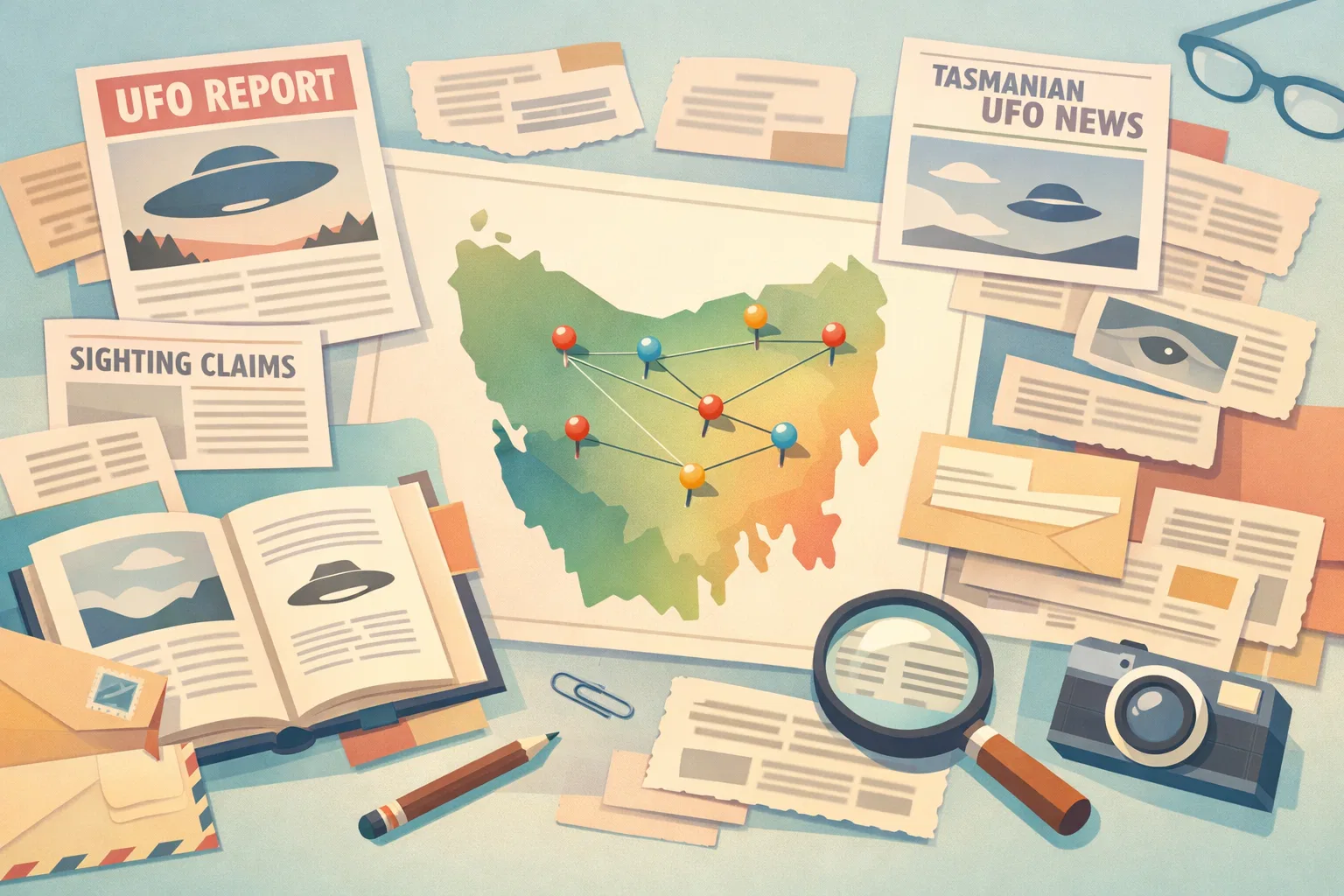
Civilian investigators helped preserve many Tasmanian reports that might otherwise survive only as scattered clippings.
On this page
- Tasmania's civilian UFO investigation tradition
- Newsletters, retyped catalogues and case summaries
- Strengths and limits of amateur archives
Page outline Jump by section
Introduction
The Tasmania UFO Investigation Centre, usually shortened to TUFOIC, matters because it helped keep Tasmania’s UFO record from disappearing into scattered memories, newspaper cuttings and ageing official files. Tasmania has famous cases, but its civilian archive is the quieter story behind them: volunteers gathered witness reports, typed summaries, circulated newsletters, indexed cases and preserved local material that a national archive or newspaper database would not necessarily keep in one place. TUFOIC was not an official government body, and its files should not be treated as proof that unusual reports were extraterrestrial. Its value is archival and investigative: it shows what Tasmanians reported, how civilian investigators tried to check those reports, and where the evidence remained too thin for firm conclusions.
That distinction is important. TUFOIC’s legacy is not that it solved Tasmania’s UFO history. It is that it made the state’s UFO history traceable.
Tasmania’s civilian UFO investigation tradition
TUFOIC sits within a wider Australian pattern of post-war civilian UFO groups. During the Cold War and space-race years, Australian official agencies recorded “unusual aerial sightings” partly because unknown aircraft, missiles, satellites or other objects could have national-security relevance; the National Archives of Australia notes that Royal Australian Air Force records of possible UFO sightings are now retained in the national archival collection.[NAA]naa.gov.auflying saucers fact or fictionflying saucers fact or fiction Civilian groups filled a different role. They were closer to local witnesses, more willing to preserve odd reports that officials might file briefly or disregard, and more likely to circulate material to other enthusiasts and researchers.
Available secondary histories place TUFOIC’s foundation in October 1965, associated with Keith Roberts and Paul Jackson, after earlier attempts to organise Australian UFO research through state and national groups.[Wikipedia]WikipediaAustralian ufologyAustralian ufology By the early 1970s it was producing Tasmanian-focused UFO material rather than merely repeating mainland or overseas stories. That local emphasis is what makes TUFOIC important within Tasmania’s branch of Australian UFO history: it treated the island as a distinct reporting environment, with its own witnesses, roads, coastlines, air routes, small towns and repeated observation points.
The group’s strongest contribution was not a single dramatic claim. It was continuity. A local report from Latrobe, St Helens, Cressy, Maatsuyker Island, Hobart or the Midlands could be logged, compared with earlier accounts, summarised in a newsletter, and later re-used by researchers trying to reconstruct Tasmanian patterns. A 2013 review of TUFOIC’s later publication Tasmania: A UFO History described it as covering unusual aerial reports from 1898 and including newspaper clippings, object sketches, text and a short history of TUFOIC itself.[UFOs Scientific Research]ufos-scientificresearch.blogspot.comUFOs Scientific Research Unidentified Anomalous PhenomenaUFOs Scientific Research Unidentified Anomalous Phenomena
That does not make every TUFOIC file reliable. It means the files preserve the history of reporting. For UFO research, that is often the difference between a usable case and an anecdote with no date, no location and no way to check what was said at the time.

Newsletters, catalogues and case summaries
TUFOIC’s archive appears in several overlapping forms: newsletters, annual reports, catalogues, case documents and later compilations. The National Library of Australia catalogue records Tasmania: A UFO History, compiled by Keith Roberts and published in Hobart by the Tasmanian UFO Investigation Centre in 2011, as a 76-page illustrated item with facsimiles, a map and an index.[National Library of Australia Catalogue]catalogue.nla.gov.auOpen source on nla.gov.au. That library record is important because it places at least part of TUFOIC’s work in a formal collecting institution rather than leaving it only in private hands.
The newsletter run is especially revealing. A listing by Archives for the Unexplained describes issues of Tasmanian UFO Investigation Newsletter, UFO Tasmania and Tasmanian UFO Report from the late 1970s through the early 2000s, noting that every third issue was an annual-style UFO Tasmania or Tasmanian UFO Report.[afushop.se]afushop.setasmanian ufo investigation newsletter ufo tasmania (1978 2002) 1012322tasmanian ufo investigation newsletter ufo tasmania (1978 2002) 1012322 A separate historical inventory of UFO periodicals lists TUFOIC annuals for 1972, 1974, 1976-1978 and 1999, along with TUFOIC news and newsletter issues, and notes that annuals were interspersed and numbered with newsletters.[Project 1947]project1947.comOpen source on project1947.com.
That format tells the reader a lot about how the archive worked. Instead of a single polished database created at the end of the process, TUFOIC’s record grew in layers:
- Immediate report handling: a witness contacted the group or a report was passed on from another source.
- Investigator notes: a local volunteer might interview witnesses, visit a site, sketch a route, or note possible aircraft, astronomical or weather explanations.
- Newsletter circulation: the case could be summarised for members, sometimes with a cautious status such as unexplained, astronomical, satellite, balloon or still under investigation.
- Retyped catalogues and annuals: older reports were gathered into year-by-year summaries, making them easier to compare.
- Later compilations: works such as Tasmania: A UFO History pulled clippings, sketches and earlier TUFOIC material into a more accessible historical package.[UFOs Scientific Research]ufos-scientificresearch.blogspot.comUFOs Scientific Research Unidentified Anomalous PhenomenaUFOs Scientific Research Unidentified Anomalous Phenomena
A 2005 TUFOIC newsletter preserved by the Internet Archive shows the survival problem clearly. It is only four pages long, but its metadata links it to the broader UFO newsletter collection of Archives for the Unexplained in Sweden, showing how a Tasmanian civilian newsletter could end up preserved through an international network of private and specialist archives.[Internet Archive]archive.orgTUFOIC Newsletter No 097 February 2005TUFOIC Newsletter No 097 February 2005 For researchers, that matters because small-group newsletters are easy to lose: they were often photocopied, stapled, mailed to members and never deposited systematically in public libraries.
What the archive adds to famous Tasmanian cases
TUFOIC’s value becomes clearer when a case is followed beyond its headline version. The 1974 St Helens car-stop report, for example, is often remembered as an unusual encounter involving a family on a remote road in north-eastern Tasmania. A later detailed review states that Keith Roberts of TUFOIC supplied the full report, and that TUFOIC investigator Roger Brooks, then a senior master at St Marys District School, visited the Richards family’s remote farm on 21 September 1974, five days after the reported incident.[UFOs Scientific Research]ufos-scientificresearch.blogspot.comUFOs Scientific Research Unidentified Anomalous PhenomenaUFOs Scientific Research Unidentified Anomalous Phenomena
That is exactly the kind of detail that separates an archive from a legend. The names, date of visit, investigator role, road location and vehicle description do not prove the extraordinary interpretation of the event. They do, however, show that someone attempted a local follow-up soon after the report. For a historian of Tasmanian UFO culture, that is highly useful. It allows later readers to ask better questions: Were the witnesses interviewed promptly? Was the site described clearly? Were mundane explanations considered? Did later versions add details that were not in the first report?
TUFOIC material also shows how a single archive could preserve both the more dramatic and the more ordinary end of UFO reporting. In 2014, Keith Roberts reportedly supplied details of current Tasmanian reports, including a Latrobe case still under investigation and annual statistics: 29 reports so far that year, with seven attributed to astronomical causes, nine to satellites, five to balloons, four to other causes, three unexplained and one still under investigation.[UFOs Scientific Research]ufos-scientificresearch.blogspot.comUFOs Scientific Research Unidentified Anomalous PhenomenaUFOs Scientific Research Unidentified Anomalous Phenomena Those numbers are modest, but they are valuable because they show classification, not just collection. TUFOIC was not simply labelling everything mysterious; at least in that summary, most reports were being sorted into likely ordinary causes.
The same caution appears in a 1996 Tasmanian “UFO slime” episode recorded in a catalogue of Australian physical trace cases. TUFOIC received calls over about a fortnight concerning clear jelly-like deposits in Kempton and northern towns, but no UFO was reported in connection with the material; samples were obtained and analysis identified one as mollusc eggs and another as a substance from potting mix.[Project 1947]project1947.comOpen source on project1947.com. That is a small case, but it is one of the most useful examples of amateur archive discipline: an odd claim was logged, checked and weakened by mundane evidence.

Why amateur archives can be strong
Civilian UFO archives are often stronger than outsiders expect, especially when they preserve first-generation material. A newspaper article may compress a sighting into a colourful paragraph. A later retelling may add drama. A private case file can preserve the less glamorous details: the weather, the clock time, the direction of travel, the witness’s uncertainty, the investigator’s doubts, and possible explanations that did not make a good headline.
TUFOIC’s Tasmanian setting gave this kind of work particular value. Tasmania’s small population and island geography meant that many reports came from places where a local investigator could understand the landscape better than a mainland commentator. A light over Bass Strait, a shape near the Western Tiers, a road encounter near St Helens, or an object described from a coastal settlement all depend on local context: roads, hills, weather, aircraft routes, fishing activity, astronomical visibility and the habits of small communities.
The newsletters also provided a memory system. State Library of Queensland, writing about similar UFO periodicals in Queensland, notes that such publications often included the results of local investigations and provide an alternative source to newspaper reporting.[slq.qld.gov.au]slq.qld.gov.auThe Truth Is Out ThereThe Truth Is Out There That point applies strongly to TUFOIC. Even when the archive is imperfect, it offers a second route into Tasmanian UFO history: not just what newspapers found entertaining, but what investigators and witnesses thought worth recording.
Another strength is pattern recognition. A single sighting may be impossible to assess decades later, but a catalogue can reveal repeated causes. TUFOIC’s 2014 statistics, for instance, show satellites, balloons and astronomical objects accounting for a large share of reports in that year’s sample.[UFOs Scientific Research]ufos-scientificresearch.blogspot.comUFOs Scientific Research Unidentified Anomalous PhenomenaUFOs Scientific Research Unidentified Anomalous Phenomena That helps modern readers avoid a common mistake: assuming that “unidentified” means “unexplainable”. Often it means the original witness did not identify the object at the time, while later checking may narrow or solve the case.
Where the archive has limits
The same qualities that make TUFOIC’s archive valuable also create limits. It was a civilian, volunteer-driven effort. Its reports were not gathered under legal oath, its investigators did not have routine access to all aviation, military, meteorological or satellite records, and its newsletters were written for a UFO-interested readership. That does not invalidate the material, but it affects how it should be read.
The first limitation is uneven survival. Some items are in the National Library of Australia, some are listed by specialist archives, some appear in private collections, some have been digitised, and some may exist only as photocopies or references in later catalogues. The National Library record for Tasmania: A UFO History confirms institutional preservation of one major compilation, but it is a reading-room item rather than a fully open online text.[National Library of Australia Catalogue]catalogue.nla.gov.auOpen source on nla.gov.au. The Internet Archive entry for a 2005 TUFOIC newsletter shows that later newsletters can survive online, but that does not guarantee a complete, searchable run.[Internet Archive]archive.orgTUFOIC Newsletter No 097 February 2005TUFOIC Newsletter No 097 February 2005
The second limitation is case inflation. UFO archives can preserve weak reports alongside strong ones, and later readers may treat all entries as equally significant. A catalogue entry is not a verdict. It may be a brief note, a second-hand account, a press clipping, an unexplained report awaiting data, or a case already weakened by later analysis. The Kempton “slime” episode is a useful warning: without the analysis, it might sound strange; with the analysis, it becomes a record of misidentification and good follow-up.[Project 1947]project1947.comOpen source on project1947.com.
The third limitation is interpretive drift. A report written in 1974, summarised in a newsletter, retyped into a catalogue and later quoted online may subtly change each time. Names may be withheld, distances rounded, dates corrected, and dramatic details emphasised. For serious use, TUFOIC material is best compared with newspapers, RAAF files, aviation records, weather data and later sceptical reviews rather than read in isolation.
How to read TUFOIC material responsibly
The best way to use TUFOIC’s archive is not to ask, “Did this prove UFOs were alien?” A better question is, “What did Tasmanians report, how soon was it recorded, what checks were made, and what ordinary explanations were considered?”
A responsible reading gives greatest weight to cases with named or well-described witnesses, close-in-time interviews, site visits, sketches, multiple independent accounts, aviation or astronomical checks, and clear separation between what the witness said and what the investigator inferred. The St Helens example is stronger as an archive item because it includes a prompt local follow-up by an identified TUFOIC investigator.[UFOs Scientific Research]ufos-scientificresearch.blogspot.comUFOs Scientific Research Unidentified Anomalous PhenomenaUFOs Scientific Research Unidentified Anomalous Phenomena The 2014 statistics are useful because they show identified causes as well as unexplained cases, giving a glimpse of how reports were filtered.[UFOs Scientific Research]ufos-scientificresearch.blogspot.comUFOs Scientific Research Unidentified Anomalous PhenomenaUFOs Scientific Research Unidentified Anomalous Phenomena
By contrast, entries that survive only as a title, a short catalogue line, a dramatic claim, or a later paraphrase should be treated as leads rather than conclusions. They may still matter historically, especially if they show a local flap or public concern, but they do not carry the same evidential weight as a well-documented investigation.
This approach also keeps Tasmania’s UFO history balanced. TUFOIC preserved mystery, but it also preserved mundane explanation. Its archive contains the raw material of belief, doubt, local memory and practical checking. That mixture is more useful than a simple believer-versus-sceptic frame.
Why TUFOIC still matters for Tasmania
TUFOIC’s importance lies in the way it bridges official and local memory. The Commonwealth record preserves RAAF and government interest in unusual aerial sightings; newspapers preserve what editors thought newsworthy; TUFOIC preserved what local UFO investigators and witnesses thought should not be lost. Those are different kinds of evidence, and Tasmania’s UFO history needs all three.
For a public reader, the main takeaway is simple: TUFOIC did not make Tasmania’s UFO stories true, but it made many of them recoverable. Its newsletters, annual reports, catalogues and later compilations give researchers something to test against other records. They help distinguish a famous case from a faint rumour, a still-unresolved report from a likely satellite, and a local legend from a documented investigation.
That is why TUFOIC belongs at the centre of any serious page on Tasmania’s civilian UFO archives. The group’s work shows how much of UFO history depends not on spectacular proof, but on ordinary acts of preservation: taking the call, writing down the time, keeping the clipping, visiting the road, filing the sketch, noting the likely planet, and saving the report long enough for later readers to ask better questions.
Amazon book picks
Further Reading
Books and field guides related to Who Kept Tasmania's UFO Stories Alive?. Use these as the next step if you want deeper reading beyond the article.
The UFO Experience
Focuses on evaluating reports and case records, closely matching archival UFO investigation themes.

UFOs : Generals, Pilots, and Government Officials Go on the R...
Fits the investigative-documentation angle behind civilian UFO archives and case collections.
The Report on Unidentified Flying Objects
Documents the collection and assessment of sighting reports, paralleling archival work.
Passport to Magonia
Provides historical context for preserving and comparing unusual reports across time.
eBay marketplace picks
Marketplace Samples
Live-tested eBay searches with available results related to this page.


Endnotes
1.
Source: naa.gov.au
Title: flying saucers fact or fiction
Link:https://www.naa.gov.au/blog/flying-saucers-fact-or-fiction
2.
Source: Wikipedia
Title: Australian ufology
Link:https://en.wikipedia.org/wiki/Australian_ufology
3.
Source: catalogue.nla.gov.au
Link:https://catalogue.nla.gov.au/catalog/6150730
4.
Source: afushop.se
Title: tasmanian ufo investigation newsletter ufo tasmania (1978 2002) 1012322
Link:https://www.afushop.se/store/p/0/tasmanian-ufo-investigation-newsletter-ufo-tasmania-%281978-2002%29-1012322
5.
Source: project1947.com
Link:https://www.project1947.com/shg/bgper.htm
6.
Source: archive.org
Title: TUFOIC Newsletter No 097 February 2005
Link:https://archive.org/details/TUFOIC_Newsletter_No_097_February_2005
Published: February 2005
7.
Source: project1947.com
Link:https://www.project1947.com/kbcat/kbtrace0505.htm
8.
Source: slq.qld.gov.au
Title: The Truth Is Out There
Link:https://www.slq.qld.gov.au/blog/truth-out-there-queensland-ufo-related-periodicals
9.
Source: catalogue.nla.gov.au
Link:https://catalogue.nla.gov.au/catalog/2770135
10.
Source: Wikipedia
Title: UFO học Úc
Link:https://vi.wikipedia.org/wiki/UFO_h%E1%BB%8Dc_%C3%9Ac
11.
Source: Wikipedia
Title: Maxime Cressy
Link:https://en.wikipedia.org/wiki/Maxime_Cressy
12.
Source: project1947.com
Title: Sign Historical Group
Link:https://www.project1947.com/shg/osu_t_z.htm
13.
Source: project1947.com
Link:https://www.project1947.com/kbcat/kbvalent.htm
14.
Source: project1947.com
Link:https://www.project1947.com/forum/bctrace2.htm
15.
Source: project1947.com
Title: “Unusual Aerial Sightings”
Link:https://www.project1947.com/kbcat/kb_uasgov.htm
16.
Source: project1947.com
Title: Keith Basterfield
Link:https://www.project1947.com/kbcat/kbmoreintoz.htm
17.
Source: project1947.com
Link:https://www.project1947.com/shg/proceedings/shgproceed1.pdf
18.
Source: project1947.com
Link:https://www.project1947.com/kbcat/kbabduct0505.htm
19.
Source: libraries.tas.gov.au
Link:https://libraries.tas.gov.au/slat/
20.
Source: naa.gov.au
Link:https://www.naa.gov.au/visit-us/tasmania
21.
Source: naa.gov.au
Title: ufo sightings weapons testing site woomera
Link:https://www.naa.gov.au/students-and-teachers/student-research-portal/learning-resource-themes/war/defence-equipment-and-weapons/ufo-sightings-weapons-testing-site-woomera
22.
Source: recordsearch.naa.gov.au
Title: View Image.aspx
Link:https://recordsearch.naa.gov.au/SearchNRetrieve/Interface/ViewImage.aspx?B=30030606&S=1
23.
Source: osa.tas.gov.au
Link:https://osa.tas.gov.au/
24.
Source: find-and-update.company-information.service.gov.uk
Title: company-information.service.gov.uk CRESS Y LIMITED overview
Link:https://find-and-update.company-information.service.gov.uk/company/03299561
25.
Source: archive.org
Link:https://archive.org/stream/AustralianUFOFiles/A703_554-1-30_Part%202_12055824_djvu.txt
26.
Source: nationalarchives.gov.uk
Link:https://www.nationalarchives.gov.uk/help-with-your-research/research-guides/ufos/
27.
Source: slwa.wa.gov.au
Link:https://slwa.wa.gov.au/stories/slwa-abc-radio/truth-not-out-there
28.
Source: findandconnect.gov.au
Title: archives tasmania
Link:https://www.findandconnect.gov.au/entity/archives-tasmania/
29.
Source: library.gov.au
Link:https://www.library.gov.au/term/tasmania
30.
Source: service.tas.gov.au
Link:https://www.service.tas.gov.au/services/education-and-skills/libraries/explore-the-state-library-and-archives-of-tasmania
31.
Source: assets.publishing.service.gov.uk
Link:https://assets.publishing.service.gov.uk/media/5a79dfc9ed915d042206ba86/UFOReport2001.pdf
32.
Source: are.na
Link:https://www.are.na/patricia-klein/alien-aesthetics-66skfzi6dvo
33.
Source: ufos-scientificresearch.blogspot.com
Title: UFOs Scientific Research Unidentified Anomalous Phenomena
Link:https://ufos-scientificresearch.blogspot.com/2013/01/tasmania-ufo-history.html
34.
Source: ufos-scientificresearch.blogspot.com
Title: UFOs Scientific Research Unidentified Anomalous Phenomena
Link:https://ufos-scientificresearch.blogspot.com/2014/01/a-detailed-look-at-1974-st-helens.html
35.
Source: ufos-scientificresearch.blogspot.com
Title: UFOs Scientific Research Unidentified Anomalous Phenomena
Link:https://ufos-scientificresearch.blogspot.com/2014/10/?m=1
36.
Source: facebook.com
Link:https://www.facebook.com/groups/1586408548258884/posts/3561110637455322/
37.
Source: ufos-scientificresearch.blogspot.com
Link:https://ufos-scientificresearch.blogspot.com/2014/01/
38.
Source: ufos-scientificresearch.blogspot.com
Link:https://ufos-scientificresearch.blogspot.com/2018/10/many-digitised-australian-periodicals.html
39.
Source: tennisexplorer.com
Link:https://www.tennisexplorer.com/player/cressy/
Additional References
40.
Source: youtube.com
Link:http://www.youtube.com/watch?v=nZ6s2NmySbs
Source snippet
"TUFOIC" OR "Tasmanian UFO Investigation Centre" Enemy Aliens - The Suspense is Awful: Tasmania and the Great War Tasmanian Museum and Ar...
41.
Source: youtube.com
Link:http://www.youtube.com/watch?v=8yFIRaalq10
Source snippet
Inside the Australian UFO Archive: Tullamarine, Goulburn, and the Townsville Radar Case...
42.
Source: youtube.com
Title: TERRIFYING UFO Sightings and Alien Abduction in Tasmania Australia
Link:http://www.youtube.com/watch?v=DqNptXsmNrQ
Source snippet
Inside the Australian UFO Archive: The Sea Fury, Maralinga, and the [Valentich]({{ 'valentich/' | relative_url }}) Mystery...
43.
Source: youtube.com
Title: The End of Investigation ~ Tasmanian UFO Investigation Centre
Link:http://www.youtube.com/watch?v=aFHu-jfGOlA
Source snippet
VufoA - Tv On Location in Cressy Tasmania...
44.
Source: youtube.com
Link:http://www.youtube.com/watch?v=0xahit30_3E
Source snippet
TERRIFYING UFO Sightings and Alien Abduction in Tasmania Australia...
45.
Source: linkedin.com
Link:https://www.linkedin.com/pulse/australias-forgotten-uap-record-now-part-disclosure-dr-andrew-btobc
46.
Source: scribd.com
Link:https://www.scribd.com/document/492616223/Australian-UFO-Magazine
47.
Source: merriam-webster.com
Link:https://www.merriam-webster.com/dictionary/cressy
48.
Source: instagram.com
Link:https://www.instagram.com/maximecressy/?hl=en
49.
Source: reddit.com
Link:https://www.reddit.com/r/UFOs/comments/1rkiay1/national_archives_documents_reveal_royal/
Topic Tree