Within NT UFOs
Were Katherine's 1974 Lights Rocket Debris?
The 1974 reddish tailed lights near Katherine show how a dramatic multi-location sighting can later fit a space-debris explanation.
On this page
- What witnesses reported on 15 October 1974
- How RAAF investigators checked orbital causes
- Why re entry events can look extraordinary
Page outline Jump by section
Introduction
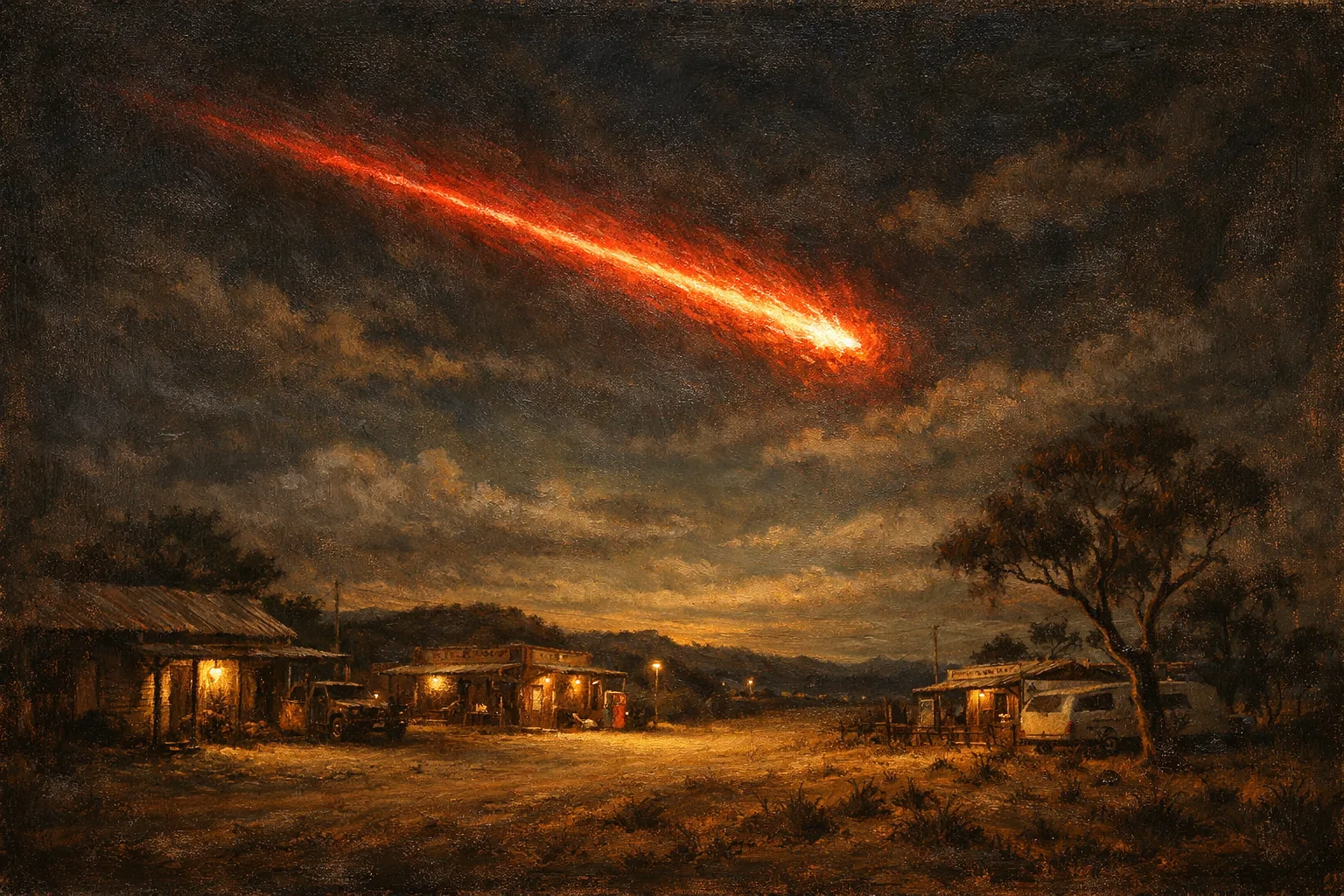
The Katherine lights of 15 October 1974 are one of the Northern Territory’s clearest examples of a dramatic UFO report that later fits a space-debris explanation better than an exotic one. Witnesses in Katherine, and at several places around Fitzroy Crossing in Western Australia, reported a group of reddish, tailed lights moving rapidly across the evening sky shortly after 8 pm. RAAF Base Darwin treated the reports seriously enough to issue a written response and to pass the original sightings to Defence in Canberra for further checking. Its early view was that the cause was probably man-made: satellite or rocket material becoming incandescent during re-entry.[Internet Archive]archive.orgInternet Archive Full text of "Australian UFO FilesInternet Archive Full text of "Australian UFO Files
That matters because the case shows both sides of good UFO history in the Northern Territory. The sighting was unusual, multi-location and memorable, but it was also time-specific, geographically coherent and consistent with an orbital re-entry. Later re-entry cataloguing has strengthened the mundane reading by linking the event to the decay of an American Agena-D rocket body associated with ATS-1, visible over Katherine and the Kimberley at about 10:45 UTC, or around 8:15 pm local Northern Territory time.[Satellites Observed]satobs.orgOpen source on satobs.org.
What witnesses reported on 15 October 1974
The core event took place on Tuesday 15 October 1974. According to the RAAF Darwin letter dated 17 October, reports came in the following morning from Katherine in the Northern Territory and from localities around Fitzroy Crossing in Western Australia. The description was not of a single hovering craft or a close landing, but of “a group of reddish ‘tailed’ lights” moving quickly across the sky from the south-west towards the north-west shortly after 8 pm.[Internet Archive]archive.orgInternet Archive Full text of "Australian UFO FilesInternet Archive Full text of "Australian UFO Files
Those details are important. A multi-point sighting over northern Australia narrows the explanation. A low aircraft, car reflection, local flare or small balloon would not normally account for similar reports across such a wide region. But a high-altitude object breaking up on re-entry could be seen from widely separated places, especially across the open skies of the Northern Territory and the Kimberley.
The colour and shape also matter. Witnesses did not merely report ordinary white points of light. They reported reddish lights with tails, which is exactly the kind of description that can feel “UFO-like” to someone seeing it unexpectedly. It suggests motion, heat, fragmentation and a trail. In the UFO record, these are often the features that make a report sound extraordinary. In a re-entry record, they are also features that make the case more explainable.
The RAAF did not dismiss the reports as imagination. Its Darwin office wrote to the editor of the Northern Territory News, acknowledged multiple reports, and described a preliminary investigation. That response gives the case more value than an isolated anecdote, because it preserves the time, place, direction, colour and official first assessment in a contemporary document.[Internet Archive]archive.orgInternet Archive Full text of "Australian UFO FilesInternet Archive Full text of "Australian UFO Files

How RAAF investigators checked orbital causes
RAAF Base Darwin’s preliminary conclusion was that the most probable cause was man-made. The letter stated that calculations indicated several possible orbital objects should have been visible at about the time and in the area of the reports: a “PAC-A satellite” launched in 1969, an OAO-3 rocket launched in 1972, and discarded remnants from their launch stages. The same letter also allowed for short-lived satellite or rocket stages, or other man-made objects, becoming incandescent as they re-entered after long periods in orbit.[Internet Archive]archive.orgInternet Archive Full text of "Australian UFO FilesInternet Archive Full text of "Australian UFO Files
That wording is cautious, not absolute. The RAAF was not saying, “we have recovered the object” or “this exact piece of hardware has been proven beyond doubt.” It was saying that orbital calculations and the nature of the reports made a re-entry explanation the leading candidate. The original sighting reports were to be sent to the Department of Defence Air Office in Canberra for fuller investigation, with the promise that the newspaper would be informed if a different cause emerged.[Internet Archive]archive.orgInternet Archive Full text of "Australian UFO FilesInternet Archive Full text of "Australian UFO Files
A later piece of RAAF guidance in the same file is useful for understanding the official mindset. It advised investigators not to name an exact piece of suspected space debris too readily, because the precise object often could not be identified from unclassified records. Instead, reports should be classified as “probable space debris” or “probable meteorite” where appropriate. The note added a simple observational distinction: space debris usually has an orange or red tail, while a meteorite often has a blue or green-tinged tail.[Internet Archive]archive.orgInternet Archive Full text of "Australian UFO FilesInternet Archive Full text of "Australian UFO Files
That guidance fits the Katherine case closely. The witnesses described reddish tailed lights, and the event occurred across a broad viewing area at a specific evening time. The official explanation did not depend on claiming that witnesses were unreliable. It depended on recognising that a genuine, spectacular sky event can still be artificial debris.
Why later re-entry catalogues strengthened the explanation
The strongest later support comes from specialist re-entry cataloguing. Ted Molczan’s catalogue of visually observed natural re-entries lists an event on 15 October 1974 at 10:45 UTC involving object 1966-110B: the rocket body from the American ATS-1 launch, an Agena-D stage of roughly 750 kg. The listed sighting locations include Katherine in the Northern Territory and, in later versions, Cockatoo Island, Derby and Fitzroy Crossing in Western Australia. The cited sources include the RAAF file E1327 5/4 Air Part 6/7 and a Western Australia Police file.[Satellites Observed]satobs.orgOpen source on satobs.org.
This does not erase the RAAF’s earlier mention of other possible objects, such as OAO-3 material. It shows how later orbital-history work can refine a preliminary official explanation. The key point is that the overall category — man-made orbital debris re-entering the atmosphere — becomes stronger, even if the exact candidate object shifted as better cataloguing became available.
ATS-1 itself was a real NASA Applications Technology Satellite, launched in December 1966 aboard an Atlas-Agena rocket. NASA describes the ATS programme as a set of experimental satellites for communications, meteorological and scientific technology, and NOAA notes that ATS-1 was carried into geostationary orbit by a NASA Atlas rocket on 6 December 1966.[NASA]nasa.govdecember 1966 applications technology satellite 1 ats 1december 1966 applications technology satellite 1 ats 1[NOAA Satellite & Information Service]nesdis.noaa.govthe 50th anniversary of ats 1the 50th anniversary of ats 1 The re-entry catalogue identifies the object associated with the 1974 sighting not as the operational satellite itself, but as the ATS-1 rocket body, catalogued separately as 1966-110B.[Satellites Observed]satobs.orgOpen source on satobs.org.
That distinction is easy to miss but important. UFO retellings often flatten “satellite”, “rocket”, “spacecraft” and “debris” into one vague term. In this case, the more precise reading is that the likely culprit was a discarded launch vehicle stage: a large, dead piece of orbital hardware, not a controlled aircraft and not an active satellite performing a manoeuvre.
Why re-entry events can look extraordinary
A re-entering rocket body can look stranger than many people expect. The Aerospace Corporation’s re-entry explainer notes that space debris is human-made material in Earth orbit, often travelling roughly parallel to the ground at about 7 km per second, and that re-entries can resemble bright meteors with a central body, a long tail and numerous fragments.[The Aerospace Corporation]aerospace.orgOpen source on aerospace.org.
That description helps explain the Katherine reports. A spent rocket stage does not have to appear as a neat single dot. As it descends into thicker atmosphere, heating, stress and breakup can produce several glowing pieces. To observers on the ground, that can look like a formation of lights, a craft shedding sparks, or several objects travelling together. In a dark Northern Territory sky, with few visual reference points, the effect can be especially striking.
The apparent direction can also mislead. Witnesses saw the lights moving from south-west to north-west, which may sound like purposeful flight. But a re-entry track across the upper atmosphere can produce a smooth, fast, directional passage across a large arc of sky. Because the object is high and bright, people separated by hundreds of kilometres may report the same event from slightly different angles.
The RAAF’s own later guidance about colour is also relevant. It treated orange or red tails as a clue favouring space debris, while blue-green tails leaned more towards meteorite reports.[Internet Archive]archive.orgInternet Archive Full text of "Australian UFO FilesInternet Archive Full text of "Australian UFO Files That is only a rule of thumb, not a laboratory test, but it matches the Katherine wording unusually well: reddish, tailed lights seen over a broad region at a time later associated with a known rocket-body re-entry.
What this case tells us about Northern Territory UFO history
The Katherine case is valuable because it is not just another “lights in the sky” story. It is a case where the evidence chain moves in the right direction: contemporary reports, official acknowledgement, preliminary orbital checking, later specialist re-entry identification, and a physical mechanism that matches the witness description.
For Northern Territory UFO history, that makes it a useful counterweight to more folklore-heavy material. Places such as Wycliffe Well became famous because repeated stories and roadside culture turned the Territory’s night sky into a UFO landscape. Katherine’s 1974 lights show a different pattern: the same vast skies can produce reports that sound dramatic but are better understood through aviation, astronomy and space-tracking records.
The case also shows why “explained” does not mean “uninteresting”. A rocket-body re-entry over Katherine would still have been spectacular. Witnesses may well have seen something rare, bright and memorable. The mistake would be to jump from “unusual” to “unknown craft” when the timing, colour, direction and multi-location pattern all point towards orbital debris.
What remains uncertain
The main uncertainty is not whether witnesses saw something. The official record accepts that multiple reports were received. The uncertainty is how precisely to identify the object. RAAF Darwin’s preliminary letter mentioned several possible man-made candidates, including a PAC-A satellite, an OAO-3 rocket and discarded launch-stage remnants. Later re-entry catalogues identify the event as the re-entry of 1966-110B, the ATS-1 Agena-D rocket body.[Internet Archive]archive.orgInternet Archive Full text of "Australian UFO FilesInternet Archive Full text of "Australian UFO Files[Satellites Observed]satobs.orgOpen source on satobs.org.
That difference should not be overplayed. It weakens any claim that the RAAF’s first object identification was final, but it strengthens the broader explanation that investigators were looking in the right category. The consistent thread is not “this named object was immediately and perfectly identified”. It is “the sighting behaved like man-made space debris, and later orbital cataloguing supports that reading”.
The case would be stronger still if all original witness forms, newspaper coverage and police reports were easily accessible side by side. The surviving public trail is good enough to make the rocket-debris explanation persuasive, but not rich enough to reconstruct every observer’s exact line of sight, duration estimate, emotional reaction or local viewing conditions.
Best assessment
The 1974 Katherine lights are best classed as a probably explained UFO report: a genuine unusual aerial sighting, probably caused by the atmospheric re-entry of man-made rocket debris. The case is stronger than a casual debunk because the explanation does not rely on vague scepticism. It rests on a specific date, a narrow time window, multiple locations, a red-tailed visual description, contemporary RAAF investigation and later re-entry cataloguing.
For a Northern Territory UFO page, the lesson is straightforward. Some sightings remain weakly documented or genuinely unresolved. Katherine’s 1974 lights are different. They show how an event can be startling enough to generate UFO reports, serious enough to enter RAAF files, and still ordinary in origin once orbital debris is considered.
Amazon book picks
Further Reading
Books and field guides related to Were Katherine's 1974 Lights Rocket Debris?. Use these as the next step if you want deeper reading beyond the article.
The UFO Experience
Explains how investigators evaluate UFO reports and distinguish extraordinary claims from astronomical or mundane causes.
UFOs Explained
Focuses on misidentifications and conventional explanations, closely matching a rocket-debris interpretation.
The Hynek UFO Report
Examines real case investigations and the process of assessing witness reports.

UFOs : Generals, Pilots, and Government Officials Go on the R...
Provides context on how official investigations handle unusual aerial reports.
eBay marketplace picks
Marketplace Samples
Example marketplace items related to this page. Use the search link to explore similar finds on eBay.


Endnotes
1.
Source: archive.org
Title: Internet Archive Full text of “Australian UFO Files”
Link:https://archive.org/stream/AustralianUFOFiles/E1327_5-4-AIR_part%206-7_7061048_djvu.txt
2.
Source: nasa.gov
Title: december 1966 applications technology satellite 1 ats 1
Link:https://www.nasa.gov/image-article/december-1966-applications-technology-satellite-1-ats-1/
Published: december 1966
3.
Source: nesdis.noaa.gov
Title: the 50th anniversary of ats 1
Link:https://www.nesdis.noaa.gov/news/the-50th-anniversary-of-ats-1
4.
Source: aerospace.org
Link:https://aerospace.org/article/what-does-reentry-look-like
5.
Source: ntrs.nasa.gov
Link:https://ntrs.nasa.gov/api/citations/19670010952/downloads/19670010952.pdf
6.
Source: science.nasa.gov
Link:https://science.nasa.gov/mission/oao/
7.
Source: svs.gsfc.nasa.gov
Link:https://svs.gsfc.nasa.gov/12916
8.
Source: ntrs.nasa.gov
Link:https://ntrs.nasa.gov/citations/19690014660
9.
Source: heasarc.gsfc.nasa.gov
Link:https://heasarc.gsfc.nasa.gov/docs/copernicus/copernicus.html
10.
Source: nasa.gov
Link:https://www.nasa.gov/wp-content/uploads/2023/04/1974.pdf
11.
Source: orbitaldebris.jsc.nasa.gov
Link:https://orbitaldebris.jsc.nasa.gov/reentry/
12.
Source: archive.org
Link:https://archive.org/stream/the-world-book-encyclopedia-volume-1-a/The%20World%20Book%20Encyclopedia%2C%20Volume%201%20A_djvu.txt
13.
Source: aerospace.org
Link:https://aerospace.org/reentries
14.
Source: aerospace.org
Title: brief history space debris
Link:https://aerospace.org/article/brief-history-space-debris
15.
Source: aerospace.org
Link:https://aerospace.org/article/space-debris-101
16.
Source: satobs.org
Link:https://www.satobs.org/reentry/Visually_Observed_Natural_Re-entries_latest_draft.pdf
17.
Source: satobs.org
Title: Visually Observed Natural Re entries DRAFT 10
Link:https://satobs.org/seesat_ref/misc/Visually_Observed_Natural_Re-entries_DRAFT_10.pdf
18.
Source: satobs.org
Title: Visually Observed Natural Re entries DRAFT 8
Link:https://satobs.org/seesat_ref/misc/Visually_Observed_Natural_Re-entries_DRAFT_8.pdf
19.
Source: satobs.org
Title: Visually Observed Natural Re entries DRAFT 1
Link:https://satobs.org/seesat_ref/misc/Visually_Observed_Natural_Re-entries_DRAFT_1.pdf
20.
Source: assets.publishing.service.gov.uk
Title: ufo report 1997
Link:https://assets.publishing.service.gov.uk/media/5a758d2fe5274a6faebebd11/ufo_report_1997.pdf
21.
Source: Wikipedia
Title: Space debris
Link:https://en.wikipedia.org/wiki/Space_debris
22.
Source: library.dbca.wa.gov.au
Link:https://library.dbca.wa.gov.au/static/Journals/080052/080052-18.03.pdf
23.
Source: territorystories.nt.gov.au
Link:https://territorystories.nt.gov.au/10070/198775/0
24.
Source: parlinfo.aph.gov.au
Title: aph.gov.au Northern Territory
Link:https://parlinfo.aph.gov.au/parlInfo/search/display/display.w3p%3Bquery%3DId%3A%22publications%2Ftabledpapers%2FHPP032016006821_3%22%3Bsrc1%3Dsm1
25.
Source: ftp.dwer.wa.gov.au
Title: dwer.wa.gov.au Kimberley Metals Group Pty Ltd: Matsu Project
Link:https://ftp.dwer.wa.gov.au/permit/9277/Appendices%207%268.pdf
26.
Source: media.nationalarchives.gov.uk
Link:https://media.nationalarchives.gov.uk/index.php/ufo-file-release-august-2010/
27.
Source: n2yo.com
Link:https://www.n2yo.com/satellite/?s=2608
28.
Source: epa.wa.gov.au
Title: Valhalla Flora and Fauna Survey
Link:https://www.epa.wa.gov.au/sites/default/files/PER_documentation2/Appendix%20C%20-%20Flora%20and%20Fauna%20Report.pdf
Additional References
29.
Source: instagram.com
Link:https://www.instagram.com/reel/DXOUvU4Eohk/
30.
Source: nextspaceflight.com
Link:https://nextspaceflight.com/launches/details/2856/
31.
Source: facebook.com
Link:https://www.facebook.com/groups/2607225699502851/posts/2654434454781975/
32.
Source: facebook.com
Link:https://www.facebook.com/groups/gippslandhistory/posts/2929782907251717/
33.
Source: space4water.org
Link:https://www.space4water.org/space/applications-technology-satellite-ats-1
34.
Source: facebook.com
Link:https://www.facebook.com/groups/165143940728168/posts/1982166915692519/
35.
Source: academia.edu
Link:https://www.academia.edu/93809025/Beyond_the_big_run_station_life_in_Australias_last_frontier
36.
Source: facebook.com
Link:https://www.facebook.com/groups/340988663878839/permalink/719601309350904/
37.
Source: facebook.com
Link:https://www.facebook.com/KUSINews/posts/debris-from-partially-burned-up-spacecraft-components-and-satellites-reentering-/1425678262938467/
38.
Source: facebook.com
Link:https://www.facebook.com/10newsplus/videos/did-you-happen-to-see-this-mysterious-ufo-an-expert-reveals-what-the-unusual-sig/856929463667961/
Topic Tree